
Cannabis Concentrates
What Are Full-Spectrum Extracts and How Do They Compare?
Sep
Cannabis concentrates can look deceptively similar. Two oils may have nearly identical colors and THC percentages, yet their chemical profiles, aromas, extraction methods, and overall characteristics can be very different.
One term you will frequently encounter is full-spectrum extract.
Full-spectrum extracts are generally designed to retain a broad range of compounds naturally present in cannabis rather than isolating one cannabinoid such as THC or CBD. Depending on the starting material and extraction process, that broader profile can include major cannabinoids, minor cannabinoids, terpenes, and other plant compounds.
But there is an important catch: “full spectrum” is not a guarantee that every compound in the original cannabis flower remains unchanged in the finished extract. Extraction itself is selective, and processing conditions can alter the final chemical profile.
That distinction becomes particularly important when comparing full spectrum vs live resin, distillate, isolate, and other concentrates.
In this guide, you will learn what full-spectrum cannabis extracts actually are, how cannabis extraction influences their composition, how they compare with other concentrates, and what information you should check before choosing a product.
What Are Full-Spectrum Extracts?
A full-spectrum cannabis extract is generally an extract intended to preserve a broad assortment of the naturally occurring chemical compounds found in its cannabis starting material.
Cannabis contains numerous biologically active compounds. The best-known are cannabinoids such as delta-9-tetrahydrocannabinol (THC) and cannabidiol (CBD), but the plant also contains minor cannabinoids, terpenes, flavonoids, and other constituents.
The FDA notes that cannabis contains more than 80 biologically active chemical compounds, with THC and CBD among the most widely recognized. THC is primarily responsible for marijuana’s intoxicating effects.
A full-spectrum product may contain compounds such as:
- THC or THCA
- CBD or CBDA
- CBG
- CBC
- CBN
- Terpenes such as myrcene, limonene, pinene, and beta-caryophyllene
- Other naturally occurring plant constituents
Terpenes are volatile aromatic compounds responsible for much of the characteristic smell and flavor associated with cannabis and many other plants.
Instead of concentrating almost exclusively on a single cannabinoid, as highly refined products can, full-spectrum extraction generally attempts to maintain greater chemical diversity.
That does not necessarily mean that every full-spectrum product contains the same compounds or ratios.
The cultivar, cultivation environment, harvest timing, storage conditions, starting material, extraction solvent, temperature, pressure, and post-processing methods can all influence the final extract.
What Does “Full Spectrum” Really Mean?
This is where cannabis terminology becomes complicated.
There is no simple assumption that a product described as full spectrum contains literally every compound that existed in the harvested plant.
Extraction is inherently selective.
Different solvents dissolve different compounds with different efficiencies, while processing steps can remove waxes, lipids, chlorophyll, terpenes, or other constituents.
Research comparing cannabis and hemp extraction techniques demonstrates this clearly. One study comparing hydrodistillation, supercritical CO2, and ethanol extraction found substantially different cannabinoid and terpene profiles among the resulting extracts.
Research has also documented significant terpene losses during some forms of cannabis processing, particularly among more volatile monoterpenes. This means terms such as “whole plant” and “full spectrum” should not automatically be interpreted as meaning that an extract perfectly reproduces the chemistry of the original flower.
A practical definition is therefore:
A full-spectrum extract aims to preserve a broader range of naturally occurring cannabis compounds than highly refined extracts or isolated cannabinoids.
When shopping, treat “full spectrum” as the beginning of your investigation rather than the end of it.
The product’s laboratory results can tell you much more.
How Cannabis Extraction Works
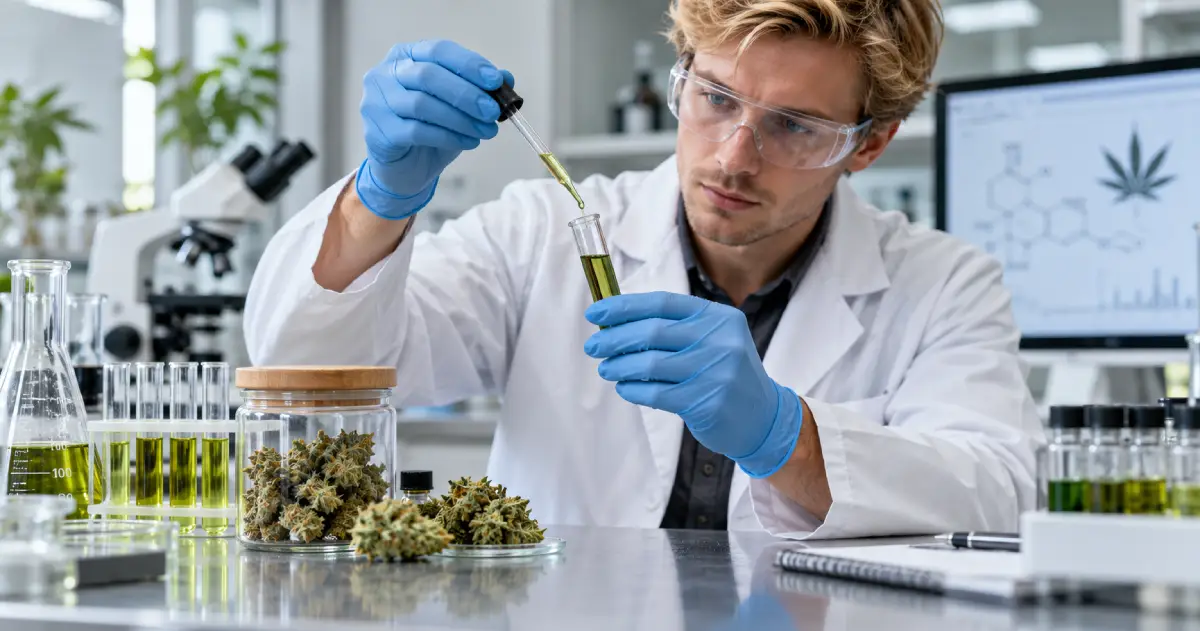
Cannabis extraction is the process of separating desirable chemical compounds from cannabis plant material to produce a concentrated extract.
Cannabinoids and many terpenes are concentrated in tiny resin-producing structures called trichomes, particularly on cannabis flowers.
Commercial processors can use several techniques to separate these compounds from plant material.
Depending on the desired product, processing may involve extraction followed by filtration, solvent removal, winterization, decarboxylation, distillation, crystallization, or other refinement steps. Scientific reviews note that extraction and purification methods can significantly affect the compounds ultimately retained in the product.
Three commonly discussed approaches are hydrocarbon, CO2, and ethanol extraction.
Hydrocarbon Extraction
Hydrocarbon extraction commonly uses solvents such as butane or propane in specialized closed-loop equipment.
The solvents dissolve cannabinoids and terpenes from the plant material. The solvent must subsequently be removed from the resulting concentrate.
Hydrocarbon extraction is commonly associated with concentrates including:
- Live resin
- THC Sauce
- Badder or budder
- Shatter
- Wax
Processing conditions matter considerably. Temperature, solvent composition, starting material, and post-extraction handling can change what remains in the finished concentrate.
Commercial hydrocarbon extraction requires specialized equipment and controlled conditions because the solvents involved are highly flammable. It should not be confused with a safe DIY extraction method.
CO2 Extraction
Carbon dioxide can become a supercritical fluid when placed under specific temperature and pressure conditions. In this state, CO2 exhibits characteristics that allow it to act as an extraction solvent.
Processors can manipulate pressure and temperature to target different components.
CO2 extraction has therefore become one method used commercially to produce cannabis and hemp extracts.
However, the use of CO2 does not automatically make an extract full spectrum. The final chemical composition still depends on extraction parameters and subsequent processing.
Research comparing extraction techniques found that supercritical CO2 extraction produced a different cannabinoid and terpene composition from ethanol extraction and hydrodistillation.
Ethanol Extraction
Ethanol can dissolve cannabinoids along with other compounds from cannabis biomass.
Temperature is particularly important.
In one controlled study examining cold ethanol extraction, extraction temperature affected terpene retention. The researchers reported substantially greater terpene losses at some temperatures compared with extraction performed at −40°C.
Ethanol extraction can be useful at commercial scale, but additional processing may be required depending on the desired finished product.
Again, the solvent alone does not determine whether something deserves to be called full spectrum.
Full Spectrum vs Live Resin: What Is the Difference?
The full spectrum vs live resin comparison causes confusion because these categories can overlap.
They describe different things.
Full spectrum describes the intended breadth of the chemical profile.
Live resin describes a concentrate primarily by its starting material and processing approach.
Live resin is made from cannabis that is frozen soon after harvest rather than being dried and cured first. The purpose is to preserve volatile compounds—particularly aromatic terpenes—that can otherwise be lost between harvesting and extraction.
As a result, live resin frequently retains a complex cannabinoid and terpene profile.
That means a live resin can potentially be considered full spectrum, but “live resin” and “full spectrum” are not interchangeable definitions.
Think about it this way:
Full spectrum = chemical-profile concept
Live resin = fresh-frozen extraction category
The distinction matters when reading product labels.
A manufacturer might produce a full-spectrum extract from cured cannabis, while another might produce live resin from fresh-frozen cannabis. Both can preserve multiple cannabinoids and terpenes even though the starting materials and resulting profiles differ.
Live resin is particularly associated with preserving volatile terpenes that may be reduced during conventional drying and curing.
Full Spectrum vs Live Resin at a Glance
| Feature | Full-Spectrum Extract | Live Resin |
| Main defining feature | Broad chemical profile | Fresh-frozen starting material |
| Starting material | Can vary | Fresh-frozen cannabis |
| Terpenes | Generally retained to some degree | Terpene preservation is a major goal |
| Cannabinoids | Multiple cannabinoids may remain | Multiple cannabinoids may remain |
| Extraction method | Can vary | Commonly solvent-based |
| Flavor/aroma | Depends heavily on processing | Often emphasizes cultivar-specific aroma |
| Can be full spectrum? | Yes, by definition/positioning | Potentially |
| Automatically live resin? | No | Yes |
Neither category automatically tells you the exact THC percentage, terpene concentration, purity, or quality of a particular product.
For those details, you need the product’s laboratory analysis.
Full-Spectrum Extracts vs Distillate
Distillate represents a very different processing philosophy.
Cannabis distillate is a highly refined concentrate produced using distillation to concentrate selected cannabinoids, commonly THC or CBD.
Where full-spectrum processing generally prioritizes chemical diversity, distillation prioritizes refinement and cannabinoid concentration.
During extensive refinement, many compounds originally present in the plant can be separated from the target cannabinoid fraction.
The result can be an oil dominated by one cannabinoid.
Some manufacturers later formulate distillate with terpenes. However, adding terpenes to refined THC distillate does not necessarily recreate the original chemical ratios of the cannabis plant.
This creates a useful distinction:
Full spectrum: prioritizes retaining a range of native compounds.
Distillate: prioritizes refinement and concentration of selected cannabinoids.
Neither term alone establishes whether a product is appropriate for you. They simply describe different approaches to creating cannabis concentrates.
Full Spectrum vs Broad Spectrum
You may also encounter the term broad spectrum, especially in the hemp and CBD market.
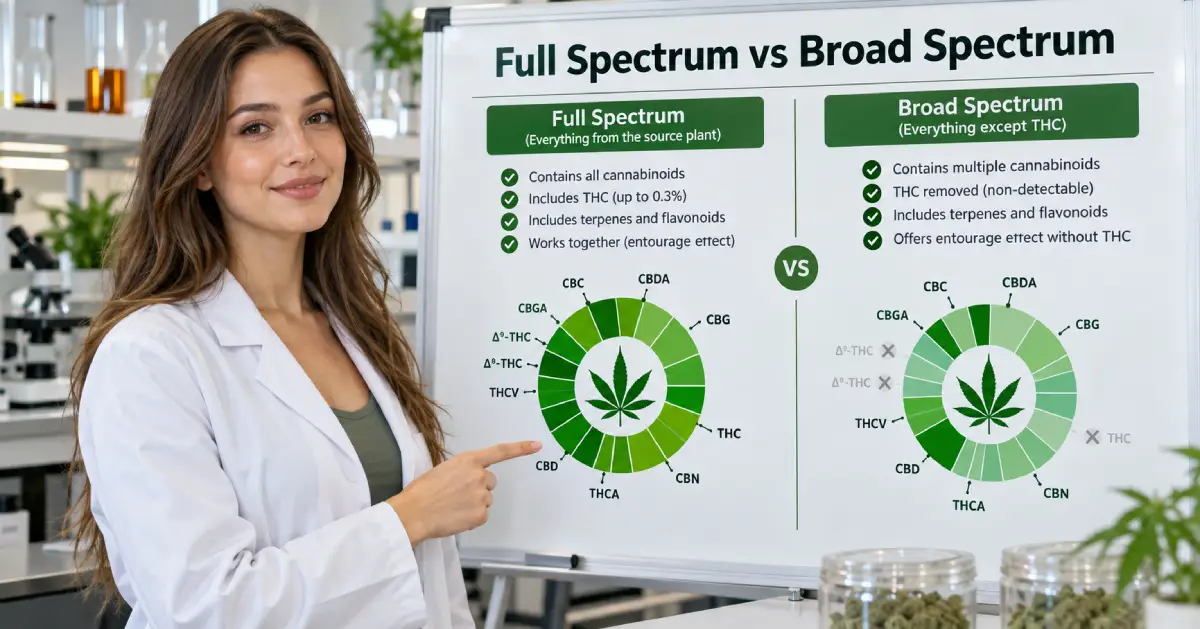
Broad-spectrum products are generally formulated to contain multiple cannabis-derived compounds while excluding or substantially reducing THC.
The terminology is common in CBD products, although individual formulations can vary considerably.
Conceptually:
Full spectrum: multiple cannabis compounds, potentially including THC.
Broad spectrum: multiple cannabis compounds, typically formulated without meaningful THC.
Isolate: primarily one isolated cannabinoid.
Because terminology and manufacturing standards can vary, you should verify the cannabinoid panel rather than relying entirely on the front label.
Full-Spectrum Extracts vs Isolates
An isolate sits at the opposite end of the spectrum from a chemically diverse extract.
Cannabinoid isolates are highly purified forms of individual cannabinoids.
For example, CBD isolate consists predominantly of cannabidiol rather than the broader collection of cannabinoids and terpenes found in a less-refined extract.
This makes the comparison relatively straightforward.
A full-spectrum extract is about complexity, while an isolate is about specificity and purity of an individual compound.
An isolate may be useful when manufacturers want predictable formulations based around a specific cannabinoid. Full-spectrum extracts are more relevant when preserving multiple naturally occurring constituents is the goal.
What Is the “Entourage Effect”?
Discussions of full-spectrum cannabis frequently lead to the entourage effect.
The term broadly describes the hypothesis that multiple cannabis compounds may interact in ways that produce effects different from those of isolated cannabinoids.
It is an interesting research area, but it is also frequently oversimplified in cannabis marketing.
There is scientific research investigating interactions among cannabinoids, terpenes, and other cannabis compounds, and reviews have discussed possible biological mechanisms associated with full-spectrum preparations. However, evidence is not sufficient to assume that every full-spectrum product will produce a particular therapeutic benefit or will necessarily be superior to an isolate for every purpose.
The composition of cannabis extracts also varies dramatically.
Two products marketed as full spectrum can contain different cannabinoid concentrations, terpene profiles, and ratios.
You should therefore be cautious with sweeping claims such as “full spectrum always works better.”
The available evidence is much more nuanced.
Does Full Spectrum Mean More Potent?
Not necessarily.
Potency and spectrum are different concepts.
When cannabis labels refer to potency, they commonly mean the concentration of THC, CBD, or another cannabinoid.
Spectrum describes chemical diversity.
A highly refined THC distillate can contain a higher percentage of THC than a terpene-rich full-spectrum concentrate.
That does not make the distillate “more full spectrum.” It simply means the products prioritize different chemical characteristics.
Similarly, a live resin could contain less THC than a distillate while retaining a broader assortment of cannabinoids and aromatic compounds.
Rather than assuming one number defines the entire product, look at its complete cannabinoid and terpene profile.
Why Terpenes Matter When Comparing Extracts
Terpenes play a major role in distinguishing one cannabis extract from another.
These volatile molecules contribute significantly to cannabis aroma.
Common cannabis terpenes include:
Myrcene: often associated with earthy, herbal aromas.
Limonene: commonly associated with citrus aromas.
Alpha- and beta-pinene: associated with pine-like aromas.
Beta-caryophyllene: often described as peppery or spicy.
Linalool: associated with floral aromas.
Terpenes are particularly sensitive to processing because many are volatile.
Scientific research has demonstrated that extraction conditions can substantially affect terpene recovery.
This is one reason comparing extracts solely by THC percentage provides an incomplete picture.
If aroma and cultivar expression matter to you, a detailed terpene analysis can provide valuable information alongside cannabinoid potency.
What Are HTFSE and HCFSE?
More specialized concentrate terminology includes HTFSE and HCFSE.
HTFSE stands for High Terpene Full-Spectrum Extract.
As its name suggests, this fraction emphasizes terpene-rich components.
HCFSE stands for High Cannabinoid Full-Spectrum Extract.
This fraction emphasizes cannabinoids and can contain crystalline cannabinoid material.
These terms often appear around products such as terpene-rich sauces and concentrates containing THCA crystals.
They are useful reminders that even within the broad category of full-spectrum extracts, chemical composition and physical consistency can vary substantially.
How to Compare Full-Spectrum Cannabis Products
If you are comparing cannabis concentrates, do not rely on a single buzzword.
Look at the complete product.
1. Check the Starting Material
Determine whether the concentrate was produced from fresh-frozen or dried and cured cannabis.
If you are specifically comparing full spectrum vs live resin, this is one of the most important distinctions.
Fresh-frozen starting material points toward live resin, while full-spectrum extracts can be produced from other forms of cannabis material.
2. Review the Cannabinoid Profile
Look beyond total THC.
Depending on the product, laboratory testing may list:
- THC
- THCA
- CBD
- CBDA
- CBG
- CBGA
- CBC
- CBN
A more detailed cannabinoid panel gives you a better idea of the chemical composition than marketing language alone.
3. Look at the Terpene Analysis
If available, examine both total terpene content and individual terpene concentrations.
This can help you understand the aromatic profile of the extract.
4. Check the Extraction Method
Look for information about whether the product uses hydrocarbon, CO2, ethanol, solventless processing, or another method.
Remember that extraction technology can influence the resulting cannabinoid and terpene profile.
5. Look for Independent Laboratory Testing
A certificate of analysis (COA) is a laboratory report showing testing results for a particular product or production batch.
Depending on state requirements and the laboratory panel, a COA may provide information about cannabinoid potency and contaminants.
When available, make sure the report corresponds with the actual batch or lot number on the product.
6. Do Not Shop by THC Percentage Alone
Higher THC does not automatically mean higher quality.
A concentrate’s value may also depend on its starting material, terpene preservation, cannabinoid diversity, extraction quality, formulation, and testing.
Comparing those characteristics gives you a much more complete picture than simply choosing whichever label displays the largest number.
Are Full-Spectrum Extracts the Same as Whole-Plant Extracts?
The terms are sometimes used interchangeably, but they should be interpreted cautiously.
A manufacturer may use “whole plant” to communicate that an extract retains compounds from the broader cannabis plant profile rather than containing a single purified cannabinoid.
However, an extract cannot necessarily reproduce every component and ratio found in the original plant.
Research comparing cannabis flower with processed extracts has documented losses of volatile terpenes, demonstrating why literal interpretations of “whole plant” or “full spectrum” can be misleading.
Instead of relying on these phrases alone, examine measurable product information.
A COA showing cannabinoids and terpenes is more informative than an unsupported “whole plant” claim on packaging.
Are Full-Spectrum Extracts Safe?
“Full spectrum” does not automatically mean safe, clean, or high quality.
It describes the intended chemical breadth of an extract—not whether the product has been properly manufactured or tested.
Cannabis products can also produce side effects, and THC-containing products can cause intoxication and impairment. The FDA continues to warn that cannabis-derived compounds can carry risks and that many products have not been evaluated or approved as drugs.
The FDA also advises against cannabis, THC, and CBD use during pregnancy or breastfeeding.
If you use cannabis, responsible considerations include following applicable state laws, checking laboratory information where available, keeping cannabis securely away from children and pets, and avoiding driving or operating machinery while impaired.
If you take medications or have questions about cannabis and a health condition, speak with a qualified healthcare professional rather than relying on product marketing for medical guidance.
Full Spectrum vs Live Resin vs Distillate vs Isolate
Here is the simplest way to understand the major categories:
| Product | Primary Goal | Typical Chemical Diversity | Key Distinction |
| Full-spectrum extract | Preserve broad plant chemistry | Broad | Multiple native compounds retained |
| Live resin | Preserve fresh-frozen plant characteristics | Often broad | Made from fresh-frozen cannabis |
| Distillate | Refine selected cannabinoids | Narrower | Highly refined cannabinoid concentrate |
| Broad-spectrum extract | Retain multiple compounds while limiting THC | Broad but selectively formulated | Common in CBD/hemp products |
| Isolate | Purify one cannabinoid | Very narrow | Primarily a single cannabinoid |
The categories can overlap.
For example, live resin can retain a broad enough chemical profile to be marketed as full spectrum. Meanwhile, a full-spectrum extract does not have to be live resin because it can originate from dried and cured material.
That is the key to understanding full spectrum vs live resin: one term describes the breadth of compounds, while the other primarily describes how the starting cannabis is preserved before extraction.
Frequently Asked Questions About Full-Spectrum Extracts
Is live resin full spectrum?
Live resin can retain a broad range of cannabinoids and terpenes and may be described as full spectrum, but the terms are not synonymous. Live resin specifically refers to concentrates produced using fresh-frozen cannabis, whereas full spectrum describes the intended breadth of compounds retained.
Is full spectrum stronger than distillate?
Not necessarily. Distillate can contain a very high concentration of a particular cannabinoid such as THC. Full-spectrum extracts instead emphasize maintaining multiple compounds. THC percentage and chemical diversity measure different characteristics.
Does full spectrum contain THC?
A marijuana-derived full-spectrum extract can contain THC. Hemp-derived formulations vary, and federal and state rules may differ. Always check the product’s cannabinoid analysis and applicable laws.
What is the difference between full spectrum and broad spectrum?
Full-spectrum products generally retain multiple naturally occurring compounds and may contain THC. Broad-spectrum products generally retain multiple compounds while removing or substantially reducing THC.
What is the difference between full spectrum and isolate?
Full-spectrum extracts contain multiple cannabis-derived compounds. An isolate is highly purified around one cannabinoid, such as CBD.
Is full spectrum the same as full extract cannabis oil?
The terminology can overlap in the marketplace, but naming conventions are not always standardized. Check the actual cannabinoid and terpene profile instead of assuming two products are chemically identical because they use similar terminology.
Does full spectrum mean solventless?
No. A full-spectrum extract may be made using solvents such as hydrocarbons, ethanol, or CO2 depending on the product. “Full spectrum” refers primarily to chemical breadth rather than whether a solvent was used.
Understanding Full-Spectrum Extracts Before You Buy
The easiest mistake to make with cannabis concentrates is assuming that one label tells you everything about the product.
It does not.
Full-spectrum extracts generally aim to retain a broad collection of cannabinoids, terpenes, and other naturally occurring cannabis compounds. But cultivation, starting material, temperature, extraction technique, refinement, and storage can all influence how much of that original chemical diversity reaches the finished product.
The same principle helps resolve the full spectrum vs live resin question.
Full spectrum describes chemical breadth. Live resin describes a concentrate made from fresh-frozen cannabis with an emphasis on preserving volatile compounds. Distillate emphasizes refinement, while isolate takes purification even further toward an individual cannabinoid.
Instead of searching for one universally “best” extract, compare the characteristics that matter for the product you are considering: cannabinoid profile, terpene content, starting material, extraction method, laboratory results, and formulation.
If you are exploring different cannabis concentrates or searching for cannabis extracts near me, Buy My Weed USA offers a range of products alongside educational resources designed to help you better understand cannabis formats, terminology, potency, https://www.leafly.com/learn/cannabis-glossary/high-terpene-full-spectrum-extract-htfseand extraction methods before making your selection.
References
Leafy. (nd). High Terpene Full Spectrum Extract (HTFSE). Available at: https://www.leafly.com/learn/cannabis-glossary/high-terpene-full-spectrum-extract-htfse
U.S. Food and Drug Administration. (03/05/2020). What You Need to Know (And What We’re Working to Find Out) About Products Containing Cannabis or Cannabis-Derived Compounds, Including CBD. Available at: https://www.fda.gov/consumers/consumer-updates/what-you-need-know-and-what-were-working-find-out-about-products-containing-cannabis-or-cannabis
Maayah ZH, Takahara S, Ferdaoussi M, Dyck JRB. (2020 Jul 1). The molecular mechanisms that underpin the biological benefits of full-spectrum cannabis extract in the treatment of neuropathic pain and inflammation. Biochimica et Biophysica Acta – Molecular Basis of Disease. 2020. Available at: https://pubmed.ncbi.nlm.nih.gov/32201189/
