
Pre Rolls
THCA Pre-Rolls: The Future of Cannabis?

Sep
THCA pre-rolls have become one of the most talked-about products in the American cannabis and hemp markets. They combine the convenience of a ready-to-smoke joint with flower naturally rich in tetrahydrocannabinolic acid (THCA), the chemical precursor to delta-9 THC.
But there is much more to the story than convenience.
Search for the best THCA pre rolls today and you will find everything from simple whole-flower joints to diamond-infused cones and concentrate-filled “hash holes.” Current buyer guides increasingly compare products based on potency, flower quality, construction, price, strain selection, and Certificates of Analysis (COAs).
At the same time, the legal environment surrounding these products is changing rapidly. A major federal change scheduled for November 12, 2026 could dramatically reshape the hemp-derived THCA market.
So, are THCA pre-rolls really the future of cannabis?
They may represent where cannabis product design is heading—toward convenience, stronger lab transparency, premium cannabis flower, and increasingly specialized formats—but the future of the hemp-derived THCA pre-roll market is considerably less certain.
Here is what you should understand before buying or smoking one.
What Are THCA Pre-Rolls?
THCA pre-rolls are ready-made joints containing cannabis flower rich in tetrahydrocannabinolic acid.
THCA is a cannabinoid naturally produced by the cannabis plant. A cannabinoid is one of the many chemical compounds found in Cannabis sativa, including THCA, THC, CBD, CBDA, and CBG.
Fresh cannabis primarily produces acidic cannabinoids such as THCA rather than large amounts of delta-9 THC.
That distinction changes when heat enters the equation.
Heating THCA causes decarboxylation, a chemical reaction in which THCA loses a carboxyl group and converts into delta-9 THC. USDA hemp-testing guidance specifically requires testing methods that account for THCA’s potential conversion into THC.
When you light a THCA pre-roll, combustion supplies that heat.
In simplified terms:
THCA + heat → delta-9 THC
This explains an apparent contradiction that sometimes confuses new consumers: raw THCA itself is not equivalent to activated delta-9 THC, yet smoking THCA-rich flower can produce an intoxicating cannabis experience because much of the THCA is converted during heating.
A pre-roll simply makes consuming that flower more convenient. The manufacturer grinds the flower, fills a paper cone or roll, adds a filter or crutch where applicable, and packages the finished product.
There is no grinder, rolling tray, or rolling technique required on your end.
Why Are THCA Pre-Rolls Becoming So Popular?
Convenience is probably the easiest explanation.
Traditional cannabis flower requires several steps. You need flower, something to break it apart, papers or another smoking device, and enough time and skill to prepare it.
A pre-roll removes most of that preparation.
You open the package and the product is already assembled.
But convenience alone doesn’t explain the category’s growth.
More Choices Than Traditional Pre-Rolls
The modern THCA pre-roll category includes considerably more than basic joints.
Depending on the manufacturer, you may encounter:
- Standard flower pre-rolls
- Mini pre-rolls
- Multi-packs
- Blunts
- Kief-infused pre-rolls
- THCA diamond-infused pre-rolls
- Rosin-infused pre-rolls
- Hash holes or concentrate-core joints
Recent 2026 buyer guides demonstrate how diverse the category has become, comparing everything from 0.5-gram mini joints to 2-gram rolls and diamond- or rosin-infused products.
That gives experienced consumers considerably more control over format, flower quantity, strain, cannabinoid concentration, and whether concentrates are included.
They Make Trying Different Strains Easier
Buying an eighth of flower generally means committing to approximately 3.5 grams of one strain.
Buying a single pre-roll can require a much smaller commitment.
That makes pre-rolls useful when you want to explore different cultivars without purchasing larger quantities of each.
Cannabis Consumers Already Understand the Format
There is almost no learning curve involved for someone familiar with cannabis joints.
THCA pre-rolls look familiar, are portable, and don’t require batteries or electronic hardware.
That simplicity gives them an advantage over products that require unfamiliar devices or preparation methods.
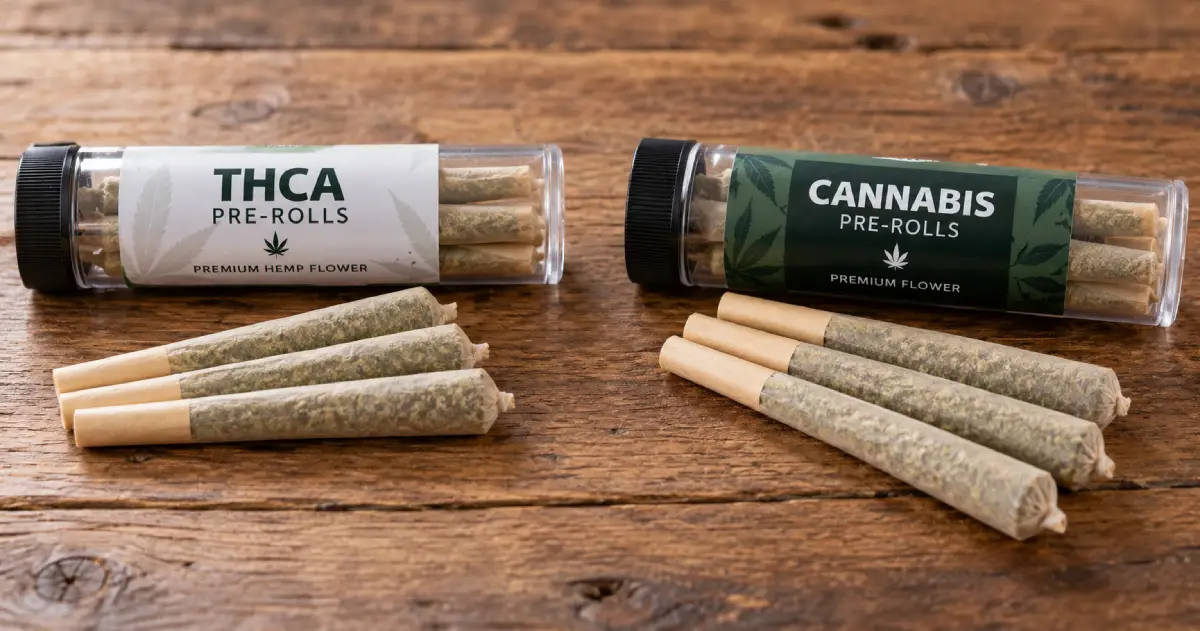
THCA Pre-Rolls vs Regular Cannabis Pre-Rolls
This comparison requires some nuance.
Chemically, THCA-rich flower and conventional marijuana flower can be much more similar than their marketing categories suggest.
Both cannabis plants naturally produce THCA. When either flower is smoked, heat converts THCA into delta-9 THC.
The biggest distinction has historically involved how the plant or finished product is classified and regulated, rather than THCA being some entirely new cannabinoid invented for hemp products.
Under the federal framework currently applicable in September 2026, the statutory definition inherited from the 2018 Farm Bill has focused on a delta-9 THC concentration of no more than 0.3% by dry weight for hemp. However, USDA production rules already require pre-harvest hemp testing to consider potential THC from THCA through total-THC testing.
And this federal landscape is about to change significantly.
More on that shortly.
What Do THCA Pre-Rolls Feel Like?
Once you smoke THCA-rich flower, the more useful comparison is generally with THC-containing cannabis rather than with non-intoxicating CBD flower.
Because heating converts THCA into delta-9 THC, THCA pre-rolls can be intoxicating.
Your experience can vary substantially depending on:
- Cannabinoid concentration
- Amount consumed
- Personal THC tolerance
- Previous cannabis experience
- Terpene profile
- Flower quality
- Whether concentrates have been added
- How deeply and frequently you inhale
- Individual physiology
A terpene is an aromatic compound found in cannabis and many other plants. Terpenes help create the aroma and flavor characteristics associated with different cannabis cultivars.
It is tempting to judge a product entirely by the THCA percentage printed on its package, but potency is only one component of the experience.
Two products with similar cannabinoid numbers can still differ in aroma, flavor, smoke quality, freshness, construction, and overall experience.
That is why the highest THCA percentage does not automatically mean the best THCA pre-roll.
How Strong Are THCA Pre-Rolls?
Strength varies enormously.
Standard THCA pre-rolls generally contain ground flower without additional concentrates. Infused products may combine flower with kief, hash, rosin, THCA diamonds, or another cannabis concentrate.
That can substantially increase cannabinoid concentration.
If you have limited THC experience, don’t assume a small pre-roll automatically represents a mild product. A compact infused roll can contain highly concentrated cannabis material.
For inhaled cannabis, effects can appear relatively quickly compared with oral products such as edibles. That makes pacing important.
Avoid driving, operating machinery, or performing safety-sensitive activities while impaired.
Standard vs Infused THCA Pre-Rolls
Understanding this distinction can prevent one of the most common purchasing mistakes.
Standard THCA Pre-Rolls
A standard pre-roll primarily contains ground THCA-rich flower.
The better products should clearly disclose what material goes inside. Ideally, you want quality flower rather than a joint primarily filled with low-grade trim.
Standard products tend to be the better starting point when your priority is evaluating the flower itself.
Infused THCA Pre-Rolls
An infused pre-roll combines cannabis flower with concentrated cannabis material.
Examples include:
THCA diamonds: highly concentrated crystalline cannabinoid material.
Kief: resinous trichome material separated from cannabis flower.
Rosin: a concentrate produced using heat and pressure rather than hydrocarbon solvents.
Hash: concentrated cannabis resin produced using various mechanical separation techniques.
Infusion can increase potency substantially, which makes direct comparisons between standard and infused products misleading.
A 1-gram whole-flower pre-roll and a 1-gram concentrate-infused pre-roll aren’t necessarily equivalent experiences simply because they weigh the same.

How to Find the Best THCA Pre-Rolls
If you are reading a THCA pre rolls review, don’t focus exclusively on whichever product has the largest potency number.
A genuinely useful review should answer several questions.
1. Is There a Batch-Specific COA?
Start with laboratory documentation.
A Certificate of Analysis (COA) is a laboratory report showing test results for a product or sample.
At minimum, cannabinoid testing can help you verify reported concentrations of compounds such as:
- THCA
- Delta-9 THC
- CBD
- CBDA
- CBG
Depending on the testing panel, reports may also provide information about contaminants.
Look for documentation that corresponds to the actual batch whenever possible rather than a generic laboratory report from an unrelated product.
2. What’s Actually Inside the Pre-Roll?
This question matters more than many consumers realize.
Once flower has been ground and packed inside opaque paper, you cannot visually inspect intact buds.
Some products use whole flower. Others may incorporate small cannabis buds, shake weed, trim, or mixtures of different materials.
This issue has become prominent enough that current THCA review sites specifically evaluate whether manufacturers disclose fillers, trim, or whole-flower contents.
Look for transparent product descriptions.
3. Is It Infused?
Always determine whether you’re purchasing regular flower or an infused product.
Infused pre-rolls should clearly explain what has been added.
Terms such as diamond-infused, rosin-infused, kief-coated, and hash hole describe materially different products.
4. Does It Burn Properly?
Potency means little if the joint is poorly constructed.
A quality pre-roll should ideally provide an even draw and relatively consistent combustion.
Packing too tightly can restrict airflow. Packing too loosely can create an uneven or fast burn.
Freshness also matters because excessively dry flower may produce a harsher smoking experience.
5. Is the Product Properly Packaged?
Cannabis quality deteriorates with inappropriate storage.
Heat, light, oxygen, and moisture conditions can affect cannabis over time.
Look for sealed packaging designed to protect the product from unnecessary environmental exposure, and follow the manufacturer’s storage instructions.
6. Is the Price Actually Competitive?
Compare price per gram, not simply package price.
For example, a $20 package containing two grams may offer better value than a $14 single one-gram roll.
For infused products, comparison becomes more complicated because concentrate type and quantity also matter.
The best value isn’t automatically the cheapest product. It is the product that offers an appropriate balance of flower quality, testing transparency, construction, freshness, and price.
What Should a Good THCA Pre-Rolls Review Include?
This is where many online reviews fall short.
A useful THCA pre rolls review should provide enough information for you to evaluate a product independently rather than simply telling you that it is “strong” or “premium.”
Look for reviews covering:
Flower source: Is the underlying cannabis flower described?
Cannabinoid profile: Is potency supported by laboratory testing?
COA accessibility: Can you find the report easily?
Batch information: Does the laboratory report correspond with the product?
Contents: Whole flower, shake, trim, or infused material?
Construction: Is the pre-roll packed consistently?
Aroma and flavor: Are descriptions specific rather than exaggerated?
Burn: Does it burn evenly?
Value: How much flower are you actually receiving?
Transparency: Does the manufacturer make verifiable information available?
That framework gives you a much stronger basis for comparison than flashy packaging or an enormous THCA number.
Are THCA Pre-Rolls Safe?
Smoking any combustible plant material exposes your respiratory system to smoke and combustion products.
That means “hemp-derived” should never be interpreted as meaning risk-free.
Cannabis can also impair attention, coordination, reaction time, and judgment. THC may cause unwanted effects in some people, particularly at higher exposures.
Your individual health history matters as well. Anyone concerned about how cannabis may interact with a medical condition or medication should discuss cannabis use with an appropriate healthcare professional.
Product quality adds another consideration.
Cannabis products can potentially contain contaminants such as pesticides, microbes, heavy metals, or residual solvents depending on cultivation and processing practices. This is another reason reputable laboratory testing and transparent sourcing deserve more attention than colorful branding.
And because THCA becomes intoxicating THC when smoked, keep these products securely away from children and pets.
Will THCA Pre-Rolls Make You Fail a Drug Test?
You should assume they can.
Smoking THCA-rich cannabis results in exposure to delta-9 THC after decarboxylation.
Many drug-testing programs look for THC metabolites rather than attempting to determine whether the cannabis product you consumed was marketed as hemp, THCA flower, or marijuana.
If your employment, athletic participation, probation, military service, or another obligation requires drug testing, a “THCA” label should not be treated as protection against a positive result.
Are THCA Pre-Rolls Legal in the United States?
This is the most important part of this guide to keep current.
The Federal Situation in September 2026
The 2018 Farm Bill defined hemp using a threshold of no more than 0.3% delta-9 THC on a dry-weight basis. This framework contributed to the emergence of retail products containing substantial THCA while reporting delta-9 THC within the statutory threshold.
However, hemp production testing has not simply ignored THCA. USDA requires compliance testing to account for potential conversion of THCA into THC and describes total THC as incorporating THC plus THCA after applying the appropriate conversion methodology.
More importantly, Congress has now enacted a different federal definition.
The Rules Are Scheduled to Change November 12, 2026
Effective November 12, 2026, federal law is scheduled to redefine hemp using a total THC concentration—including THCA—of no more than 0.3% on a dry-weight basis.
A 2026 Federal Register publication expressly confirms both the effective date and the inclusion of THCA in the revised federal definition.
Congressional Research Service analysis further explains that products excluded from the revised hemp definition would instead become subject to regulation under the Controlled Substances Act as marijuana.
The legislation also establishes additional restrictions affecting finished hemp-derived cannabinoid products, including a very low total-THC-per-container threshold.
This has enormous implications for the current high-THCA hemp market.
A flower product containing, for example, 20% or 25% THCA cannot simply disregard that THCA when evaluated under a definition explicitly based on total THC.
Consequently, many products currently marketed as hemp-derived THCA flower or THCA pre-rolls are unlikely to fit the revised federal hemp definition if the scheduled law takes effect as enacted.
State Laws Still Matter
Federal law is only one layer.
States can establish their own cannabis and hemp restrictions, including total-THC requirements, age limits, product restrictions, shipping rules, and outright prohibitions of certain cannabinoid products.
Never assume that because a website ships a product somewhere, possession or purchase is necessarily lawful in your location.
Check current state and local regulations before purchasing.
Cannabis laws are evolving quickly, so information in older THCA articles may already be outdated.
THCA Pre-Rolls vs Vapes vs Traditional Flower
THCA pre-rolls occupy an interesting middle ground.
Pre-rolls prioritize convenience. There is virtually no preparation, but combustion produces smoke.
Loose flower gives you greater control over how much you prepare and lets you visually inspect intact buds more easily, but it requires additional equipment or preparation.
Vape products eliminate the need to roll flower and do not involve combustion in the same manner as a joint, but they introduce hardware, extract formulation, manufacturing, and product-authenticity considerations.
There is no universally “best” format.
The better choice depends on what you value: convenience, flower inspection, portability, preparation, flavor, hardware requirements, or control over quantity.
Are THCA Pre-Rolls Better Than Rolling Your Own?
It depends on your priorities.
Rolling your own gives you maximum visibility into what goes into the joint. You can inspect your flower before grinding it, select the amount, choose your paper, and control how tightly it is packed.
It can also be more economical.
Pre-rolls win primarily on convenience.
They’re useful when you don’t want to carry a grinder, papers, flower, and accessories. They’re also convenient for sampling strains in smaller quantities.
The trade-off is transparency: you cannot easily inspect the original flower once it has been ground.
That makes manufacturer reputation and batch testing particularly important.
Why THCA Pre-Rolls Could Represent the Future of Cannabis
Even with major regulatory uncertainty surrounding hemp-derived THCA, the product format reveals several broader cannabis trends that are unlikely to disappear.
Convenience Is Becoming More Important
Consumers increasingly expect cannabis products that require minimal preparation.
Pre-rolls satisfy that expectation perfectly.
Products Are Becoming More Specialized
The days when every pre-roll was simply ground flower wrapped in paper are disappearing.
Consumers can now encounter different weights, strain-specific packs, minis, infused joints, concentrate cores, and premium whole-flower products.
Laboratory Transparency Is Becoming a Competitive Advantage
Modern cannabis consumers have more tools for evaluating products.
A cannabinoid percentage without supporting documentation increasingly looks incomplete compared with batch-specific testing.
Brands that make COAs easy to find give shoppers more information with which to make purchasing decisions.
Quality May Matter More Than Maximum Potency
The industry’s fascination with the highest possible THC percentage has limitations.
A genuinely premium pre-roll also depends on flower freshness, cultivar quality, terpene character, construction, airflow, storage, and transparency.
As the market matures, those characteristics may become more important differentiators.
The Biggest Challenge Facing THCA Pre-Rolls
Ironically, regulation may become both the category’s biggest challenge and its biggest catalyst for change.
The modern hemp-derived THCA industry expanded within a federal framework that distinguished hemp based on delta-9 THC concentration.
That environment is changing.
The scheduled November 2026 federal definition expressly counts THCA toward total THC.
That makes it difficult to argue that today’s high-THCA hemp pre-roll marketplace will simply continue unchanged.
Instead, the future could increasingly divide into regulated state cannabis markets, compliant low-THC hemp products, and whatever new product categories manufacturers develop in response to changing rules.
So, are THCA pre-rolls the future?
The answer is both yes and no.
The ready-to-use pre-roll format almost certainly reflects the future direction of cannabis: convenient products, strain diversity, sophisticated concentrates, better testing, and greater consumer choice.
But the current model of selling high-THCA pre-rolls specifically under the federal hemp framework faces a major legal turning point.
FAQs About THCA Pre-Rolls
Do THCA pre-rolls get you high?
They can. Although THCA is the acidic precursor to THC, heating it during smoking causes decarboxylation and converts THCA into delta-9 THC. USDA testing guidance specifically recognizes this conversion potential.
Are THCA pre-rolls the same as regular weed?
The underlying chemistry can be very similar because conventional cannabis flower also naturally contains substantial THCA before heating. The important differences have largely involved legal classification, production, testing, distribution, and marketing.
What are the best THCA pre-rolls?
The best THCA pre rolls should combine quality flower, batch-specific laboratory testing, clear ingredient disclosure, appropriate freshness, good construction, and reasonable value. Don’t select a product based solely on its advertised THCA percentage.
Are infused THCA pre-rolls stronger?
They can contain substantially higher cannabinoid concentrations because concentrates such as THCA diamonds, kief, rosin, or hash may be added to the flower. Check the product’s COA rather than assuming potency from the word “infused.”
How do you know whether a THCA pre-roll is good quality?
Check the COA, cannabinoid profile, batch information, flower source, ingredient disclosures, packaging, freshness, and whether the manufacturer specifies whole flower versus shake or trim.
Can THCA pre-rolls show up on drug tests?
Yes. You should assume that smoking THCA-rich cannabis can result in a positive THC drug test because THCA converts into THC during heating and the body subsequently produces THC metabolites.
Are THCA pre-rolls federally legal?
The answer is time-sensitive and state-specific. As of September 2026, the federal framework is undergoing a major transition. A revised hemp definition scheduled to take effect November 12, 2026 will count THCA toward a 0.3% total-THC limit, significantly changing the status of high-THCA hemp products. Always verify current federal, state, and local law.
Conclusion: So, Are THCA Pre-Rolls the Future of Cannabis?
THCA pre-rolls capture many of the trends reshaping modern cannabis.
They’re convenient. They make experimenting with different cultivars easier. They range from straightforward whole-flower joints to sophisticated concentrate-infused products. And increasing competition is pushing reputable manufacturers toward better testing and greater transparency.
But the future of THCA pre rolls shouldn’t be confused with the future of the current hemp loophole-driven marketplace.
Federal policy is changing.
Beginning November 12, 2026, unless the law changes before then, the federal hemp definition is scheduled to use total THC—including THCA—rather than the existing delta-9 THC standard. That could fundamentally reshape high-THCA products currently sold through the hemp market.
For you as a consumer, the fundamentals remain straightforward: understand what you’re buying, read the COA, distinguish standard flower from infused products, don’t equate extreme potency with quality, and verify the laws where you live.
If you’re exploring cannabis flower, pre-rolls, concentrates, or other formats, Buy My Weed USA makes it easy to compare different products and find options that suit your preferences. Whether you’re looking for premium flower, convenient pre-rolls, or potent concentrates, explore the selection from one of the best marijuana dispensary options online. Prioritize transparent product information, shop carefully, and choose quality over hype.
References:
U.S. Department of Agriculture, Agricultural Marketing Service. (n.d.) Laboratory Testing Guidelines — U.S. Domestic Hemp Production Program. Available at:
https://www.ams.usda.gov/rules-regulations/hemp/information-laboratories/lab-testing-guidelines
Federal Register / U.S. Government Publishing Office. Vol. 91, No. 81, April 28, 2026. Available at: https://www.govinfo.gov/content/pkg/FR-2026-04-28/pdf/2026-08176.pdf
Congressional Research Service. (08/17/2026). Changes to the Statutory Definition of Hemp and Implications for Agricultural Policy (IF13136). Available at:
https://www.congress.gov/crs-product/IF13136
