
Uncategorized
Shroom Tea Explained: Effects, Risks, Lemon Tek & What to Know

Sep
If you have searched for shroom tea, chances are you have encountered plenty of recipes, personal experiences, and claims about its supposed advantages over eating psychedelic mushrooms directly. You may have also encountered lemon tek, another preparation method frequently discussed in psychedelic communities.
But separating established facts from internet anecdotes isn’t always easy.
Shroom tea, sometimes called magic mushroom tea, generally refers to a beverage prepared using mushrooms containing psilocybin. Psilocybin is a naturally occurring psychedelic compound found in certain mushroom species. Once consumed, the body converts psilocybin into psilocin, a psychoactive compound that interacts primarily with serotonin receptors in the brain.
The result can include substantial changes in perception, emotions, thinking, and a person’s sense of time and surroundings. Psychedelic experiences can range from pleasant or introspective to frightening and disorienting. NIDA notes that psychedelic drugs can temporarily alter mood, thoughts, and perceptions, with reported emotions ranging from bliss to fear.
Interest in psilocybin has also moved beyond recreational settings. Scientists are investigating psychedelic compounds for potential therapeutic applications. However, research conducted under carefully controlled clinical conditions should not be confused with unsupervised recreational use. The FDA’s 2026 guidance on psychedelic drug research highlights the specialized safety and study-design considerations involved in evaluating these substances.
This guide explains what shroom tea is, why people discuss it, what lemon tek shrooms means, what science tells us about psilocybin, and the potential risks and legal considerations you should understand.
What Is Shroom Tea?
Shroom tea is a general term used for beverages containing compounds extracted from psilocybin-containing mushrooms.
You’ll sometimes see it called:
- Magic mushroom tea
- Psilocybin tea
- Mushroom tea
- Psychedelic mushroom tea
- Shrooms tea
Although these terms are often used interchangeably online, they shouldn’t be confused with ordinary mushroom beverages made from non-psychoactive culinary or functional mushrooms.
Magic mushrooms contain naturally occurring psychedelic substances called psilocybin and psilocin. Poison Control notes that these compounds can produce hallucinations, changes in time and space perception, intensified emotions, and other significant alterations in consciousness.
The word psychedelic describes substances capable of significantly changing perception, cognition, mood, and sensory experiences.
Whether mushrooms are consumed directly or incorporated into another preparation, psilocybin remains responsible for the primary psychedelic effects.
How Does Psilocybin Work?
Understanding shroom tea starts with understanding what happens to psilocybin after it enters your body.
Psilocybin itself functions largely as a prodrug. A prodrug is a substance that becomes pharmacologically active after being metabolized by the body.
After ingestion, psilocybin is converted into psilocin.
Psilocin interacts with the brain’s serotonin system, particularly receptors associated with perception and cognition. Serotonin is a neurotransmitter—a chemical messenger involved in numerous processes including mood and perception.
This activity can temporarily alter how different areas of the brain process information.
People may consequently experience changes involving visual perception, sound, emotional intensity, thought patterns, time perception, and their sense of self.
These effects can be unpredictable.
Two people consuming similar substances may have dramatically different experiences. Even the same individual can have different reactions on separate occasions.

What Does Shroom Tea Feel Like?
There isn’t one universal shroom tea experience.
Reported psychedelic effects can include changes in sensory perception, intensified colours or patterns, altered perception of time, emotional shifts, introspective thoughts, and hallucinations.
Some people describe pleasant or meaningful experiences. Others experience anxiety, paranoia, confusion, panic, or frightening hallucinations.
Poison Control identifies possible effects including hallucinations, euphoria, altered perceptions of time and space, and intensified emotions. Physical effects can include nausea, vomiting, sweating, muscle weakness, tremors, dilated pupils, and impaired coordination.
That variability is one reason anecdotal accounts shouldn’t be treated as predictions of how another person will respond.
What Is a “Bad Trip”?
A bad trip is an informal term for an intensely unpleasant psychedelic experience.
It can involve severe fear, panic, paranoia, confusion, disturbing hallucinations, or the feeling that the experience won’t end.
Because psychedelics can impair judgement and change awareness of your surroundings, psychological distress can sometimes translate into physical danger.
California Poison Control identifies impaired judgement and psychological distress among significant risks associated with psilocybin use.
How Long Can Psilocybin Effects Last?
The timeline of psychedelic effects varies considerably.
Factors influencing the experience may include individual physiology, mushroom potency, other substances or medications present, psychological state, surroundings, and the actual species or product consumed.
Poison Control reports that effects after mushroom ingestion can begin relatively quickly and continue for several hours, although individual experiences vary.
California Poison Control similarly notes that psilocybin effects commonly begin within tens of minutes and may continue for approximately four to six hours.
These figures shouldn’t be interpreted as a precise timetable.
Someone experiencing effects should not assume they’re capable of driving or performing other safety-sensitive activities simply because a particular number of hours has passed.
Why Do People Make Magic Mushroom Tea?
Searches for how to make shroom tea are common, but internet discussions surrounding the preparation frequently contain claims that haven’t been established through controlled scientific research.
For example, users may claim that tea changes nausea, onset, intensity, duration, or the overall subjective experience.
Such reports should be distinguished from clinical evidence.
A major problem with comparisons between different recreational preparations is that numerous variables change simultaneously.
Mushrooms themselves can differ in chemical composition. Individual physiology differs. Food intake varies. Preparation methods aren’t standardized. Psychological expectations can also affect the experience.
As a result, someone’s personal experience doesn’t establish that a particular preparation method caused the difference.
Does Shroom Tea Prevent Nausea?
One commonly repeated claim is that magic mushroom tea eliminates or substantially reduces nausea.
The evidence isn’t strong enough to promise that outcome.
Nausea and vomiting are recognized possible effects associated with psilocybin mushroom consumption. Poison Control specifically lists both among potential physical effects.
Individual reactions differ considerably.
Changing the way a substance is consumed doesn’t guarantee that gastrointestinal symptoms will disappear.
More importantly, reduced stomach discomfort—if it occurs for a particular individual—doesn’t eliminate the psychological and behavioural risks associated with intoxication.
What Is Lemon Tek?
If you’ve researched shroom tea, you’ve probably encountered another popular search term: lemon tek.
Lemon tek is an informal term used in psychedelic communities for a method involving psilocybin-containing mushrooms and acidic citrus juice.
Online discussions frequently claim that lemon tek shrooms produce a faster, shorter, or more intense psychedelic experience.
Those claims should be approached cautiously.
The explanations presented on forums and social media are often simplified biochemical theories rather than conclusions established by rigorous clinical trials comparing standardized lemon tek preparations against other forms of mushroom consumption.
That’s an important distinction.
Something being repeated frequently online doesn’t automatically make it scientifically established.
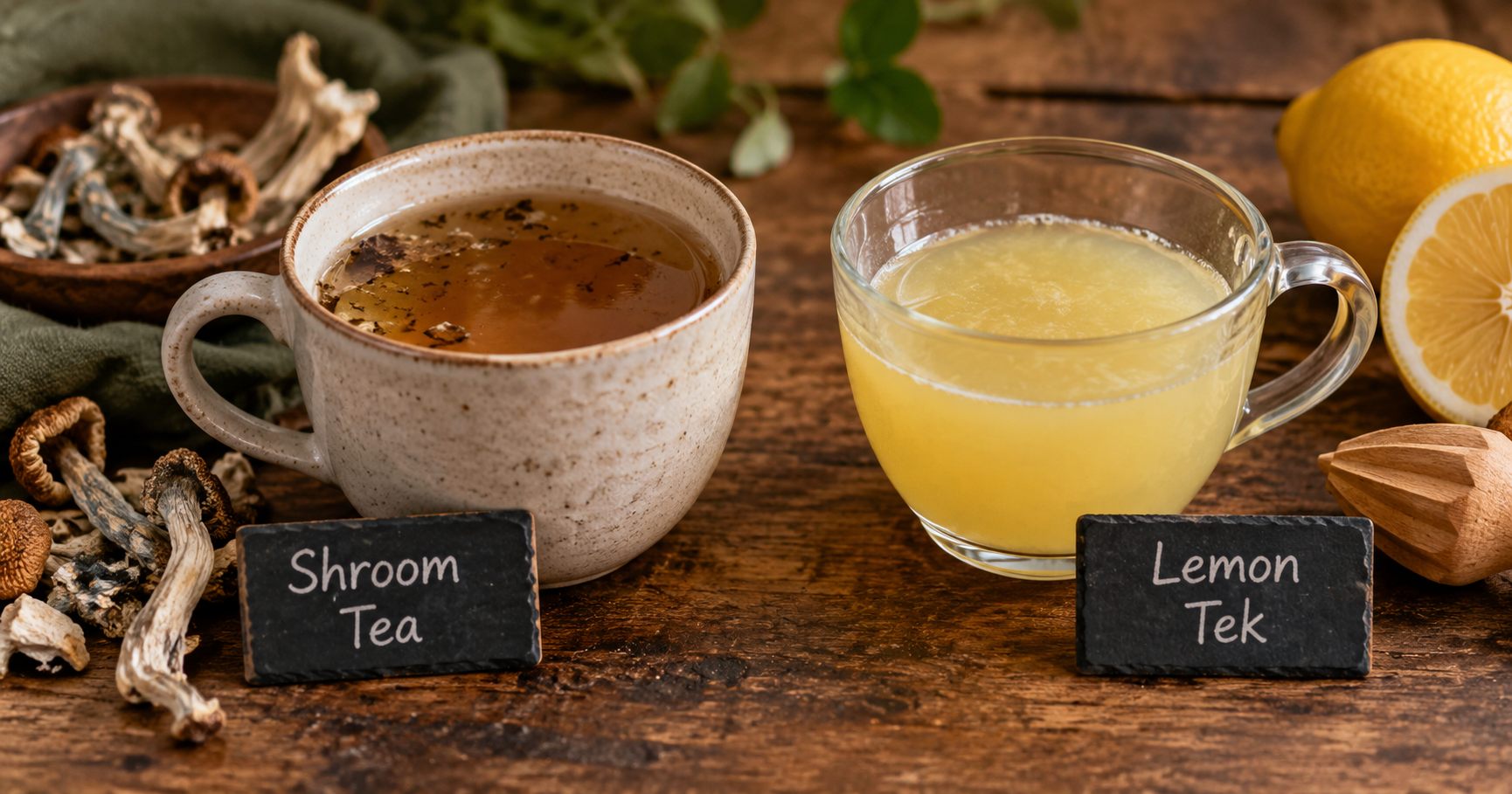
Shroom Tea vs. Lemon Tek
Shroom tea and lemon tek are often grouped together because both involve altering how mushrooms are consumed rather than simply eating dried mushroom material.
They aren’t synonymous.
Shroom tea generally describes a beverage-based preparation, whereas lemon tek specifically refers to a citrus-based preparation discussed within psychedelic communities.
Online accounts commonly compare them according to onset, duration, intensity, stomach discomfort, and taste.
However, controlled evidence directly comparing recreational preparation methods remains limited.
Therefore, statements such as “lemon tek is twice as strong” or “shroom tea always works faster” shouldn’t be treated as established facts.
Does Lemon Tek Make Shrooms Stronger?
You’ll find many confident answers to this question online.
Scientifically, the answer is less certain.
A person’s perceived intensity can be influenced by many variables beyond the preparation method itself.
These include the amount of active compounds present, mushroom species, storage conditions, individual metabolism, expectations, surroundings, emotional state, and concurrent medications or substances.
Because recreational mushroom products aren’t standardized pharmaceutical preparations, predicting potency is particularly difficult.
If someone experiences a dramatically stronger effect after using a different preparation method, that experience is genuine—but it doesn’t necessarily demonstrate why the difference occurred.
Are There Proven Benefits of Shroom Tea?
The word benefits requires careful handling when discussing psychedelics.
There is increasing scientific interest in whether psilocybin could have therapeutic applications when administered under controlled conditions.
The National Center for Complementary and Integrative Health notes that psilocybin is being studied in connection with mental-health and addiction-related conditions. However, this emerging research doesn’t establish unsupervised magic mushroom use as a safe or effective treatment.
Likewise, the FDA recognizes growing research interest in psychedelic drugs and has issued formal guidance addressing their clinical development.
Clinical research may involve carefully characterized compounds, controlled dosing, participant screening, trained personnel, structured environments, medical oversight, and follow-up.
Drinking homemade shroom tea doesn’t reproduce those conditions.
That’s why claims that magic mushroom tea can “treat depression,” “cure anxiety,” or provide other guaranteed medical benefits should be viewed critically.
Potential Risks of Magic Mushroom Tea
Psilocybin’s risks aren’t limited to having an unpleasant experience.
Possible adverse reactions associated with psilocybin mushrooms include anxiety, panic, paranoia, hallucinations, confusion, nausea, vomiting, impaired coordination, and changes in cardiovascular activity.
California Poison Control notes that increased heart rate and blood pressure may occur and identifies additional symptoms including dizziness, muscle weakness, twitching, nausea, and vomiting.
Psychological responses can be particularly significant.
Someone experiencing intense hallucinations or paranoia may lose awareness of genuine environmental hazards.
In uncommon situations, severe or persistent psychiatric symptoms may require medical attention.
Mushroom Identification Is Another Serious Risk
One risk sometimes overlooked in discussions about how to make shroom tea has nothing to do with the preparation itself.
It’s mushroom identification.
Numerous wild mushrooms can be difficult for inexperienced people to distinguish visually.
Some poisonous species can cause severe illness, organ damage, or death.
California Poison Control specifically warns that toxic mushrooms can resemble psilocybin-containing varieties and that cooking, drying, soaking, or peeling poisonous mushrooms doesn’t necessarily eliminate their toxins.
That means turning an incorrectly identified mushroom into tea doesn’t make it safe.
If someone may have eaten an unidentified or potentially poisonous mushroom, seeking professional poison-control guidance promptly is safer than waiting for symptoms.
Can Psilocybin Interact With Medications?
Potential interactions are another reason recreational psilocybin use can be unpredictable.
Psilocybin affects serotonin signalling, and certain medications also influence the serotonin system.
Poison Control notes the possibility of interactions involving serotonergic substances and discusses serotonin toxicity as a potential concern.
A serotonergic medication is a medication that affects serotonin activity.
This broad category can include some antidepressants and other prescription drugs.
Medication interactions can be complex, so you shouldn’t stop, reduce, or alter a prescribed medication in an attempt to use psychedelics. A physician or pharmacist can provide individualized information about medication interactions.
Who May Face Greater Risks?
Psilocybin isn’t equally predictable for everyone.
People with certain psychiatric or cardiovascular vulnerabilities may face additional concerns.
California Poison Control notes that risks can be heightened among people with pre-existing mental or physical health conditions and in unsupervised environments.
This is another important difference between recreational psychedelic use and clinical research.
Research programs can use extensive screening criteria to exclude participants for whom psychedelic exposure may pose unacceptable risks.
Shroom Tea and Alcohol or Other Drugs
Combining psychoactive substances introduces additional uncertainty.
Different substances can affect perception, judgement, coordination, cardiovascular function, or consciousness in different ways.
Interactions may also be difficult to predict.
The absence of an obvious immediate reaction doesn’t establish that a particular combination is safe.
When discussing psychedelic safety, avoiding assumptions about combinations is especially important because potency, individual metabolism, medications, and product composition may all vary.
What Should You Do During a Serious Adverse Reaction?
A person experiencing mild anxiety and someone experiencing a genuine medical emergency aren’t necessarily in the same situation.
Emergency symptoms can include severe confusion, loss of consciousness, seizures or convulsions, dangerous behaviour, serious breathing problems, extreme agitation, or other rapidly worsening symptoms.
California Poison Control recommends contacting the Poison Hotline at 1-800-222-1222 for unwanted or severe mushroom-related effects and calling emergency services when appropriate.
If poisonous mushroom ingestion is suspected, don’t rely on internet identification or wait for severe symptoms to appear.
Is Shroom Tea Legal in the United States?
This is another area where online information can become confusing.
At the federal level, psilocybin and psilocin remain Schedule I controlled substances under U.S. law. The federal Schedule I regulations explicitly list psilocybin and psilocyn among controlled hallucinogenic substances.
State and local policies can differ.
NCCIH notes that some jurisdictions have decriminalized, deprioritized, or otherwise changed policies surrounding psilocybin, while certain states have developed specific frameworks involving supervised administration.
“Decriminalized” also doesn’t necessarily mean “legal for unrestricted commercial sale.”
Those concepts have different legal meanings.
Because psychedelic laws are evolving, you should verify current federal, state, and local regulations rather than relying on an old article or social-media post.
Psilocybin Research vs. Recreational Magic Mushrooms
The growing scientific interest surrounding psilocybin can create a misleading impression that recreational mushrooms have already become established medicine.
They haven’t.
The FDA continues to treat psychedelic compounds as investigational drug-development subjects requiring rigorous clinical evaluation. Its finalized 2026 guidance discusses specialized considerations researchers should address when investigating psychedelic drugs.
Clinical research typically aims to answer specific questions:
Does a treatment actually work?
What adverse effects occur?
Which patients should or shouldn’t receive it?
What dose produces an appropriate risk-benefit balance?
How durable are any observed improvements?
How should participants be monitored?
Those questions require controlled evidence.
Anecdotal reports from recreational users cannot substitute for clinical trials.
Common Shroom Tea Myths
“Tea makes psilocybin completely safe.”
False.
Changing the preparation doesn’t remove psilocybin’s psychoactive effects or eliminate risks associated with impaired judgement, panic, medication interactions, or mushroom misidentification.
“Natural means harmless.”
Also false.
Many naturally occurring substances are pharmacologically active or toxic.
The fact that psilocybin occurs naturally in mushrooms doesn’t establish safety.
“Lemon tek has scientifically proven benefits.”
Evidence supporting many of the specific claims made about lemon tek remains limited.
Personal reports shouldn’t be confused with controlled clinical evidence.
“Psilocybin research proves shrooms treat depression.”
This overstates the evidence.
Researchers are studying psilocybin and related psychedelic treatments for several possible therapeutic applications, but experimental treatments delivered under clinical supervision aren’t equivalent to recreational mushroom consumption.
“You can’t have a dangerous reaction to mushrooms.”
Psilocybin may have different toxicity characteristics from some other recreational drugs, but serious psychological and behavioural reactions can still occur. Poisonous mushroom misidentification creates an additional potentially life-threatening risk.
Frequently Asked Questions About Shroom Tea
What is shroom tea?
Shroom tea generally refers to a beverage containing compounds from psilocybin-containing mushrooms. Psilocybin is converted by the body into psilocin, which produces psychedelic effects.
Is magic mushroom tea different from shroom tea?
Usually, no. Magic mushroom tea and shroom tea are commonly used as interchangeable terms.
What is lemon tek?
Lemon tek is an informal name for a citrus-based method of preparing psilocybin mushrooms. Numerous claims are made online about its effects, but controlled evidence directly comparing it with other recreational preparations is limited.
Are lemon tek shrooms stronger?
Online users frequently report differences in perceived intensity, but recreational experiences are influenced by numerous variables. Claims that lemon tek reliably increases potency by a specific amount aren’t well established by controlled scientific evidence.
Does shroom tea eliminate nausea?
Not necessarily. Nausea and vomiting remain recognized potential effects associated with psilocybin mushrooms.
How long do magic mushrooms last?
Effects can continue for several hours, but the timeline varies according to the person, product, circumstances, and other factors.
Can you drive after drinking shroom tea?
Driving or operating machinery while experiencing psychedelic effects is unsafe because perception, judgement, coordination, and awareness can be significantly altered.
Is psilocybin FDA-approved?
Research into psychedelic medicines is active, but research interest shouldn’t be interpreted as blanket FDA approval of recreational psilocybin mushrooms. FDA guidance emphasizes formal clinical investigation and safety evaluation of psychedelic drug candidates.
Are magic mushrooms legal everywhere in the US?
No. Psilocybin remains federally controlled, although some state and local jurisdictions have adopted different policies. Always check the laws applicable to your location.
Understanding Shroom Tea Without the Internet Hype
Interest in shroom tea, magic mushroom tea, lemon tek, and lemon tek shrooms has grown alongside broader public interest in psychedelic research.
But there’s an important line between what researchers have demonstrated and what users report online.
Psilocybin genuinely produces significant changes in perception and consciousness. Researchers are also investigating its potential therapeutic applications under controlled conditions. At the same time, recreational use carries psychological, behavioural, physical, medication-interaction, mushroom-identification, and legal risks.
If you’re researching psychedelics, prioritize evidence from organizations such as the FDA, NIDA, NCCIH, poison-control centres, and peer-reviewed scientific literature rather than treating social-media experiences as medical guidance.
For educational resources covering cannabis, psychedelics, terminology, emerging research, and responsible-use topics, you can continue exploring the informational guides available from BuyMyWeedUSA.com.
References:
Web MD. (2025, August 28). Psilocybin – Uses, Side Effects, and More. Available at: https://www.webmd.com/vitamins/ai/ingredientmono-1654/psilocybin
What Is Psilocybin Mushroom Tea? (2026, March 11). Available at: https://spokaneheightsdetox.com/what-is-psilocybin-mushroom-tea/
