
Cannabis
Best Weed Pipes & Bongs for a Smooth Smoke

Sep
Choosing the right smoking piece can make a noticeable difference in how you experience cannabis flower. A compact weed pipe offers simplicity and portability, while a weed bong uses water to cool and diffuse smoke before it reaches the mouthpiece.
But the biggest or most complicated piece isn’t necessarily the best.
The best weed pipes combine good airflow, quality materials, practical dimensions, durability, and easy maintenance. For some people, that means a classic glass spoon pipe. For others, a borosilicate glass bong with a diffused downstem provides the right balance between water filtration and simplicity.
If you’re shopping for your first piece—or replacing one you’ve had for years—it helps to understand what all those different materials, chambers, percolators, and designs actually do.
In this guide, you’ll learn how weed pipes and bongs differ, which designs are worth considering, what can make smoke feel smoother, and how to choose a piece that fits your preferences.
One point is important before getting started: smoother-feeling smoke does not mean harmless smoke. Public-health authorities warn that cannabis smoke contains harmful combustion products and can negatively affect lung health. Water filtration can change how smoke feels, but it doesn’t eliminate the risks associated with smoking.
Weed Pipe vs. Weed Bong: What’s the Difference?
A weed pipe and weed bong ultimately serve the same basic purpose: they provide a pathway for smoke produced from cannabis flower.
How they accomplish that is different.
A weed pipe is generally a small handheld device consisting of a bowl, airway, and mouthpiece. Most dry pipes send smoke directly from the bowl through the pipe without passing it through water.
A weed bong, often called a water pipe, contains a chamber partially filled with water. Smoke travels from the bowl through a downstem and bubbles through the water before moving into the main chamber.
Here’s a quick comparison:
| Feature | Weed Pipe | Weed Bong |
| Water filtration | Usually no | Yes |
| Portability | High | Low to moderate |
| Storage | Easy | Requires more room |
| Cleaning | Usually simple | More involved |
| Smoke cooling | Limited | Greater |
| Components | Few | Several |
| Breakability | Depends on material | Often higher with glass |
| Best for | Convenience and portability | Water-cooled draws |
Neither option is automatically superior.
Your choice should depend on where you intend to keep the piece, how much maintenance you’re willing to perform, whether portability matters, and what type of draw you prefer.
How Does a Weed Pipe Work?
Traditional cannabis pipes are relatively simple devices.
Most have several basic components.
The bowl is the cavity where cannabis flower is placed. The airway connects the bowl with the mouthpiece. Many handheld pipes also contain a carburetor, commonly shortened to “carb,” which is a small hole used to control airflow through the pipe.
Because most traditional pipes don’t contain water, smoke has a relatively short and direct route from the bowl to the mouthpiece.
That simplicity explains much of their appeal.
A weed pipe can be compact, doesn’t require water, has few removable components, and is usually easy to store.
The trade-off is that a small dry pipe provides relatively little space for smoke to cool before reaching the mouthpiece.
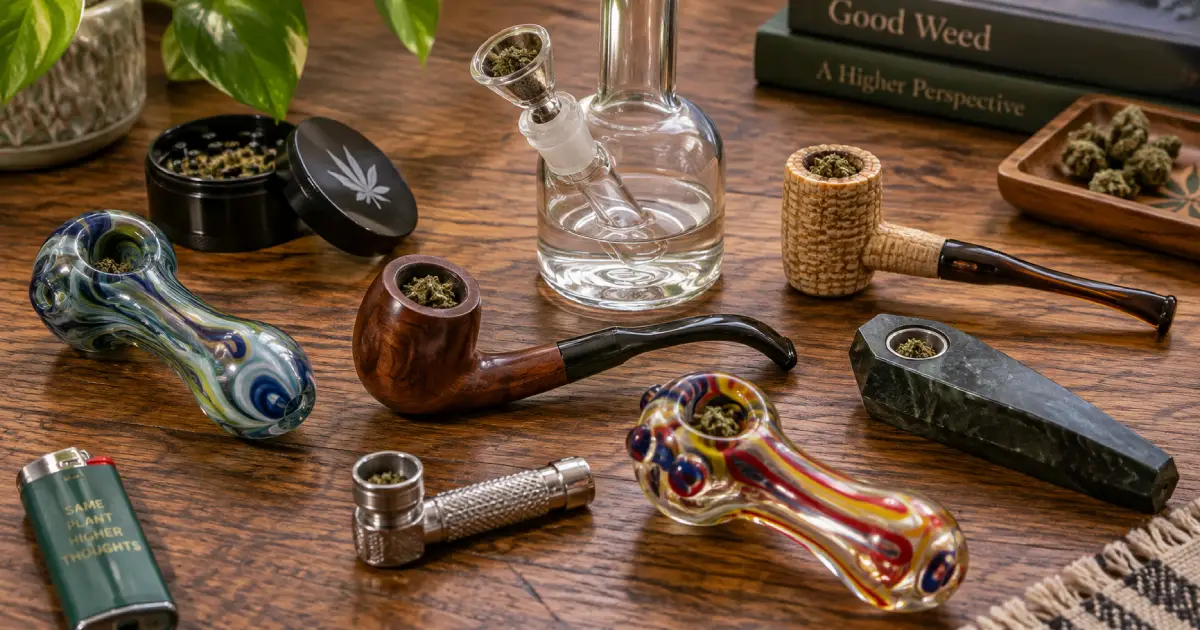
Best Weed Pipes by Type
Search for the best weed pipes and you’ll encounter thousands of designs. Most fall into a handful of established categories.
Understanding those categories makes choosing much easier.
Glass Spoon Pipes
The spoon pipe is arguably the most recognizable cannabis pipe.
It usually features a rounded bowl attached to a relatively short stem. From above, the overall shape resembles a spoon.
Glass spoon pipes are popular because they’re compact and simple. Transparent glass also allows you to see residue accumulating inside the piece, which makes it easier to tell when cleaning is necessary.
Quality glass pipes may use borosilicate glass, a type of glass designed to tolerate temperature changes better than ordinary household glass.
Spoon pipes work particularly well when you prioritize portability, uncomplicated construction, straightforward maintenance, and minimal storage requirements.
Their biggest disadvantage is fragility.
Even high-quality glass can break when dropped onto a hard surface.
Sherlock Pipes
A Sherlock pipe uses a longer curved stem inspired by traditional tobacco-pipe designs.
Moving the bowl farther away from the mouthpiece creates a distinctive appearance and a longer pathway for smoke compared with many small spoon pipes.
Sherlocks are often chosen by people who appreciate glass craftsmanship and want something more visually distinctive.
Their larger dimensions make them less convenient for carrying or compact storage.
Chillums
A chillum is a simple straight pipe with an opening for cannabis at one end and a mouthpiece at the other.
There are very few components.
That minimalism makes chillums extremely compact and easy to store. The downside is that their short smoke pathway provides relatively little opportunity for cooling.
One-Hitters
One-hitters are among the smallest cannabis pipes.
As their name suggests, they’re designed around small quantities of flower rather than the larger bowls found on many conventional pipes.
Their appeal comes primarily from compact dimensions and simple construction.
However, small airways can accumulate residue relatively quickly, making regular maintenance important.
Bubblers
A bubbler combines characteristics of a handheld pipe and water bong.
Like a pipe, it’s generally compact enough to hold comfortably. Like a bong, it contains a small water chamber that allows smoke to bubble through water before reaching the mouthpiece.
For someone who likes the convenience of a pipe but wants water filtration, a bubbler can provide an appealing middle ground.
Cleaning is the major compromise.
Small internal chambers and narrow passages may be more difficult to reach than the open interior of a simple bong.
Silicone Pipes
Silicone pipes prioritize durability.
Unlike glass, flexible silicone isn’t likely to shatter when accidentally dropped. Many designs combine a silicone body with a separate glass or metal bowl.
That makes silicone useful for people who frequently transport their accessories or simply want something less fragile.
The downside is that silicone lacks the transparency and traditional appearance of glass.
Ceramic Pipes
Ceramic allows manufacturers and artists to create pipes in unusual shapes and designs.
These pieces can feel substantial and may double as decorative objects when they’re not being used.
However, ceramic can still break when dropped.
Because it isn’t transparent, you also can’t easily inspect the inside of the pipe for buildup.
How Does a Weed Bong Work?
A weed bong adds water filtration to the basic concept of a smoking pipe.
A typical bong contains a bowl, downstem, water chamber, neck, and mouthpiece.
The downstem is a tube that directs smoke from the bowl into the water chamber. When smoke reaches the submerged portion of the downstem, it forms bubbles and passes through the water.
This process is commonly called diffusion.
The smoke then travels into the bong’s main chamber and toward the mouthpiece.
Water and the larger chamber can reduce smoke temperature before inhalation, which is why many people describe bong smoke as cooler or smoother-feeling than smoke from a short dry pipe.
Some bongs increase diffusion with specially designed downstems or internal structures called percolators.
Again, cooling and filtration should not be confused with eliminating the health risks of smoke inhalation.
Best Weed Bong Designs
There is no universally perfect weed bong.
Different designs emphasize stability, airflow, filtration, portability, or appearance.
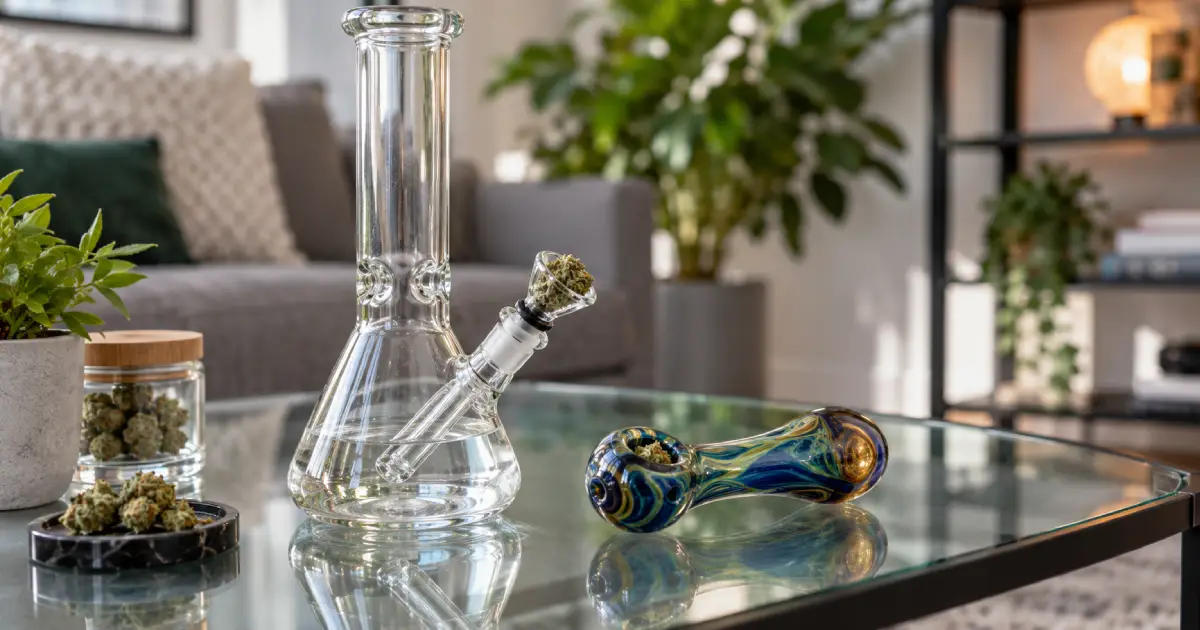
Beaker Bongs
A beaker bong has a wide base resembling laboratory glassware.
This classic shape has several practical advantages.
The broad bottom creates a stable footprint, making the bong more difficult to knock over than a narrow straight tube. Beakers can also accommodate a reasonable amount of water without requiring complicated internal chambers.
For many buyers, a simple glass beaker provides an excellent balance between function and ease of maintenance.
Straight-Tube Bongs
Straight-tube bongs use a vertical cylindrical chamber.
Their simple geometry creates a clean appearance and direct smoke pathway. Fewer curves and internal structures can also make basic straight tubes relatively easy to clean.
Their narrower footprint, however, generally provides less stability than a wide beaker base.
If you choose a tall straight tube, pay particular attention to the base.
Percolator Bongs
A percolator, often called a perc, is an internal structure designed to increase smoke diffusion through water.
Instead of allowing one larger stream of smoke to enter the water, a percolator divides it into numerous smaller bubbles.
Common styles include:
Honeycomb percolators use disc-shaped structures containing numerous small holes.
Tree percolators contain multiple branching arms with diffusion openings.
Showerhead percolators use a wider structure containing slits around the perimeter.
Inline percolators generally use horizontal tubes containing several diffusion slits.
Matrix percolators use intersecting rows of openings to create extensive bubbling.
Additional diffusion can alter the temperature and feel of smoke, but percolators create compromises.
Every extra perc introduces more surfaces where resin can accumulate. Small openings can become restricted, and complicated chambers are harder to clean.
More filtration hardware therefore doesn’t automatically create a better bong.
Mini Bongs
Mini bongs compress water-pipe functionality into a smaller package.
They’re easier to store and generally easier to move than large tabletop bongs.
However, their smaller chambers hold less water and provide shorter smoke pathways.
A mini bong makes the most sense when space and storage matter more than chamber volume.
Silicone Bongs
Silicone bongs are designed primarily around durability.
They’re much less vulnerable to accidental drops than traditional glass bongs and can be useful in situations where fragile glass isn’t practical.
Many models use removable glass bowls and other separate components.
If you’re considering silicone, check the manufacturer’s material specifications and cleaning instructions.
What Makes a Weed Pipe or Bong Feel Smoother?
“Smooth” can mean different things to different people.
Still, several design factors influence the temperature, airflow, and overall feel of smoke.
Smoke Temperature
Temperature is one of the biggest differences between small dry pipes and water pipes.
With a short pipe, there is relatively little distance between the bowl and your mouth.
A bong sends smoke through water and a larger chamber before it reaches the mouthpiece.
This additional pathway can cool smoke.
Water Diffusion
Bubbling smoke through water changes how it travels through the device.
Diffused downstems and percolators create many smaller bubbles instead of a few larger ones.
This increases interaction between smoke and water and can change the feel of the draw.
Airflow
Excellent filtration isn’t very useful if the bong is frustrating to draw through.
Airflow describes how freely air and smoke can move through the piece.
Restricted openings, dirty bowls, resin-coated downstems, or clogged percolators can all interfere with airflow.
Excessive resistance is sometimes called drag.
A well-designed bong should balance diffusion with manageable airflow.
Cleanliness
Maintenance has a major effect on performance.
Cannabis smoke leaves sticky residue commonly called resin inside bowls, pipes, downstems, and chambers.
As that buildup accumulates, it can restrict airflow and affect aroma and flavour.
Even an expensive piece can perform poorly when it hasn’t been maintained.
Best Materials for Weed Pipes and Bongs
Material is one of the most important characteristics to consider before purchasing a smoking piece.
Borosilicate Glass
Borosilicate glass is widely used for higher-quality glass pipes and bongs because of its resistance to thermal stress.
It’s also transparent.
That transparency allows you to inspect water levels, internal components, and residue without taking the piece apart.
Glass doesn’t mean indestructible, however.
Thermal resistance and impact resistance aren’t the same thing. A glass bong can still break when dropped.
Silicone
Silicone’s biggest advantage is durability.
It’s flexible, lightweight, and much more resistant to impact than glass.
That makes it useful when breakage is your primary concern.
You should still choose products designed specifically for their intended purpose and follow manufacturer instructions regarding heat exposure and cleaning.
Ceramic
Ceramic is particularly appealing for artistic pipe designs.
It can be shaped and decorated in ways that make a smoking piece look more like a sculpture or household object.
Its disadvantages include fragility and opacity.
Acrylic
Acrylic bongs tend to emphasize affordability and durability.
They’re lightweight and generally inexpensive compared with elaborate glass pieces.
However, buyers who prioritize visual clarity, glass construction, and traditional bong aesthetics often prefer borosilicate glass.
Does Weed Bong Size Matter?
Bong size matters, but bigger isn’t automatically better.
A larger bong generally provides more chamber volume and a longer smoke pathway. Larger designs may also accommodate bigger water chambers or additional filtration components.
But every increase in size creates practical compromises.
A large bong takes up more storage space, is harder to transport, can require more cleaning, and becomes more vulnerable to accidental bumps.
Smaller bongs are easier to handle and store but provide less chamber volume.
For many buyers, a medium-sized bong provides a practical middle ground.
Before buying, always check the actual measurements rather than judging scale from product photographs.
Do You Need a Percolator Bong?
Not necessarily.
A conventional bong equipped with a properly designed diffused downstem already sends smoke through water.
A percolator adds another stage of diffusion.
Whether that’s worthwhile depends on your preferences.
If easy maintenance is your highest priority, a straightforward beaker with minimal internal hardware may be ideal.
If you prioritize additional water diffusion, a bong containing one accessible percolator can offer a reasonable compromise.
If you enjoy elaborate glass and don’t mind more maintenance, multi-percolator designs provide additional complexity.
Don’t assume that three percolators automatically outperform one.
Every additional component changes airflow and creates another surface requiring cleaning.
What to Look for When Buying the Best Weed Pipes
When comparing the best weed pipes, start with function rather than decoration.
Look at the material first.
If you want traditional glass, consider quality borosilicate construction. If breakage is a major concern, silicone may be more practical.
Next, consider size.
A tiny pipe may be extremely portable but provide a short smoke pathway. A larger Sherlock can offer more distance between the bowl and mouthpiece but becomes harder to carry.
Examine the airway and bowl as well.
Extremely narrow passages can become restricted as residue accumulates.
Finally, think about cleaning before you buy.
Complex internal shapes may look impressive but can become frustrating when you can’t easily reach accumulated residue.
What to Look for When Buying a Weed Bong
Buying a bong involves several additional considerations.
Stable Construction
A wide, stable base is valuable, particularly with taller glass pieces.
Glass Quality
If you’re buying glass, construction quality and appropriate glass thickness matter more than flashy decoration.
Joint Size
Many glass bongs use standardized ground-glass joints.
Common sizes include 14 mm and 18 mm, although other sizes exist.
Knowing your bong’s joint size is important when buying replacement bowls, downstems, or compatible accessories.
Removable Components
Removable bowls and downstems can simplify maintenance and replacement.
Percolator Complexity
Consider whether you’re genuinely willing to clean the percolators you’re buying.
A beautiful multi-chamber bong can become inconvenient when sticky residue reaches areas that are difficult to rinse.
Actual Dimensions
Check height, base width, and other measurements before ordering.
Don’t rely entirely on photographs.
Best Weed Pipe for Beginners
Beginners generally benefit from simplicity.
A straightforward glass spoon pipe has relatively few components and is easy to understand.
It also lets you see residue accumulating inside the glass.
If you’re worried about breakage, a purpose-designed silicone pipe may be more practical.
If you specifically want water filtration while keeping the overall piece relatively small, a bubbler provides another option.
There’s little reason for your first pipe to contain complicated internal chambers or elaborate decorative features.
Starting simple allows you to learn which characteristics actually matter to you.
Best Weed Bong for Beginners
A basic beaker bong is a practical starting point for many beginners.
The wide base offers stability, while straightforward construction can make maintenance easier than it is with complex multi-percolator designs.
Look for a manageable size, solid construction, removable components, and an uncomplicated water chamber.
Your first bong doesn’t need multiple percolators or oversized chambers.
Once you’ve used a basic design, you’ll have a better understanding of whether you value greater diffusion, larger capacity, smaller dimensions, or easier cleaning.
Weed Pipe vs. Bong: Which Is Right for You?
Your priorities can make this decision surprisingly simple.
Choose a weed pipe if portability, easy storage, and straightforward maintenance matter most.
Choose a weed bong if you prefer water-cooled smoke and don’t mind additional cleaning and storage requirements.
Choose a bubbler if you want something between a pipe and full-sized bong.
Consider silicone when durability is a major concern.
Consider borosilicate glass when transparency, traditional construction, and easy visual inspection are priorities.
Consider a percolator bong if additional diffusion is important enough to justify extra maintenance.
There’s no universally correct choice.
The best piece is the one you’ll actually enjoy owning and maintaining.
How to Keep Weed Pipes and Bongs Clean
Keeping your smoking piece clean helps maintain airflow and prevents heavy residue buildup.
Pipes accumulate resin along their bowls and internal airways.
Bongs add water chambers, downstems, joints, and potentially percolators to the maintenance process.
Don’t leave dirty bong water sitting indefinitely.
Regular water changes and routine cleaning can prevent residue from becoming increasingly difficult to remove.
For appropriate glass pieces, isopropyl alcohol is commonly used as a cleaning agent, sometimes with coarse salt as a mechanical abrasive. Commercial cleaning products specifically formulated for smoking glass are also available.
However, you should always follow the manufacturer’s cleaning instructions.
Methods suitable for plain borosilicate glass aren’t necessarily appropriate for acrylic, painted surfaces, specialty coatings, adhesives, silicone, or decorative components.
Never mix household cleaning chemicals.
After using an appropriate cleaning method, thoroughly rinse the piece according to manufacturer directions before reuse.
Common Mistakes When Buying Weed Pipes and Bongs
A little research can prevent several common buying mistakes.
Assuming More Expensive Means Better
Price can reflect glass craftsmanship, artistic value, branding, complexity, or materials.
It doesn’t automatically guarantee that a pipe will suit your needs better.
Buying Too Much Bong
An enormous bong containing several percolators may look impressive but could be inconvenient for everyday storage and cleaning.
Consider practicality before complexity.
Ignoring Cleaning Requirements
Imagine cleaning the piece before you buy it.
If you can’t figure out how you’d reach its chambers and narrow pathways, maintenance could become frustrating.
Ignoring Joint Compatibility
When buying a glass bong, determine the joint size and downstem dimensions.
Compatible replacement components can make long-term ownership much easier.
Choosing Appearance Over Stability
Top-heavy designs can be easier to knock over.
This matters particularly with tall glass bongs.
Confusing Smoothness With Safety
Water cooling can make smoke feel different, but it doesn’t make combustion harmless.
That’s an important distinction whenever you’re evaluating claims about “smooth” smoking devices.
Are Bongs Safer Than Weed Pipes?
You should be skeptical of claims that water pipes make cannabis smoke safe.
A bong routes smoke through water, which can cool it and alter the smoking experience. However, the cannabis is still undergoing combustion.
Public-health authorities warn that cannabis smoke contains toxins, irritants, and carcinogens and can harm lung tissue.
Smoking also exposes your respiratory system to combustion products regardless of whether the smoke reaches you through a joint, pipe, or water pipe.
Therefore, terms such as “filtered” and “smooth” should describe device mechanics or sensory characteristics rather than imply that smoking is risk-free.
A smoother-feeling hit isn’t the same thing as a harmless hit.
How to Shop for the Best Weed Pipes and Bongs
Before shopping, decide what matters most to you.
Consider where you’ll store your piece.
Think about whether you need something portable or whether it will remain at home.
Be realistic about how frequently you’re willing to clean it.
Consider how concerned you are about accidental breakage.
Then establish your budget.
For a weed pipe, prioritize material, bowl design, dimensions, airflow, durability, and cleanability.
For a weed bong, consider material, chamber size, base stability, downstem design, joint dimensions, percolation, and replacement-part compatibility.
Avoid buying solely because a piece has the longest feature list.
A simple bong that you keep clean can be a much better long-term choice than an elaborate model you hate maintaining.
Frequently Asked Questions About Weed Pipes and Bongs
What Is the Best Weed Pipe?
There isn’t one universally best weed pipe. Glass spoon pipes are strong all-around options when you want simplicity, while silicone emphasizes durability. Bubblers add water filtration while maintaining relatively compact dimensions.
What Type of Weed Pipe Feels Smoothest?
A bubbler can provide more smoke cooling than a typical short dry pipe because the smoke passes through water. The perceived smoothness of any piece also depends on its dimensions, airflow, cleanliness, and design.
Is a Weed Bong Better Than a Pipe?
Not necessarily.
Bongs provide water filtration and additional smoke cooling, while pipes are smaller, easier to store, and generally simpler to maintain.
Which one is better depends on your priorities.
Are Glass Weed Pipes Better Than Silicone?
Each has advantages.
Glass offers transparency, traditional construction, and easy visual inspection. Silicone provides greater resistance to accidental drops.
Your intended use should determine which matters more.
What Is a Percolator Bong?
A percolator bong contains an internal component that divides smoke into smaller bubbles as it passes through water.
Common examples include honeycomb, tree, showerhead, inline, and matrix percolators.
Does More Percolation Mean Smoother Smoke?
Not always.
Additional diffusion can affect smoke temperature and feel, but adding percolators can also increase draw resistance and make the bong more difficult to clean.
Design quality matters more than simply counting percolators.
Are Bigger Bongs Better?
Not automatically.
Larger bongs provide more chamber volume but require additional storage and maintenance.
A medium-sized piece can provide a more practical balance for everyday use.
How Often Should You Clean a Weed Bong?
There isn’t one cleaning schedule that applies to everyone because frequency depends on use.
Change dirty water regularly and clean visible residue before buildup becomes heavy. Follow the cleaning recommendations provided by the manufacturer of your specific piece.
Can Bong Water Remove All Harmful Substances?
No.
Water filtration doesn’t make cannabis smoke harmless. Burning cannabis still produces combustion products that can affect respiratory health.
What Is the Difference Between a Bong and a Bubbler?
Both use water.
A bubbler is generally smaller and combines characteristics of a handheld pipe with a compact water chamber. A traditional bong typically has a larger chamber, removable bowl, and more capacity for features such as diffused downstems and percolators.
Finding the Best Weed Pipe or Bong for You
Finding the best weed pipes isn’t about choosing the most expensive glass or the bong containing the largest number of percolators.
It’s about matching the device to your priorities.
If you want something compact, straightforward, and easy to store, a quality weed pipe may be the most practical choice.
If water cooling and diffusion are more important, a weed bong provides those features in a wide variety of designs.
A bubbler bridges the gap between the two, while silicone offers an alternative when durability is particularly important.
Whatever design you prefer, focus on material quality, airflow, stability, dimensions, and cleanability before decorative extras.
Most importantly, keep expectations realistic. A smoking piece can alter smoke temperature, diffusion, airflow, and perceived smoothness, but it doesn’t remove the respiratory risks associated with combustion.
When you’re ready to explore quality cannabis flower and learn more about available options, visit BuyMyWeedUSA.com to browse products that fit your preferences, subject to applicable age requirements and local laws.
References:
Adrienne S.L. Medically reviewed by Debra Rose W., Ph.D., MSN, R.N., IBCLC, AHN-BC, CHT. (2019, August 26). Demystifying the Bong, One Myth at a Time. Available at: https://www.healthline.com/health/how-does-a-bong-work
Weedmaps. (2021, July 13). Pipe. Available at: https://weedmaps.com/learn/dictionary/pipe
