Shrooms
Can You Smoke Shrooms? What Science Says
Sep
If you are familiar with cannabis, you may naturally wonder whether other psychoactive substances can be consumed in similar ways. That leads to a surprisingly common question: can you smoke shrooms?
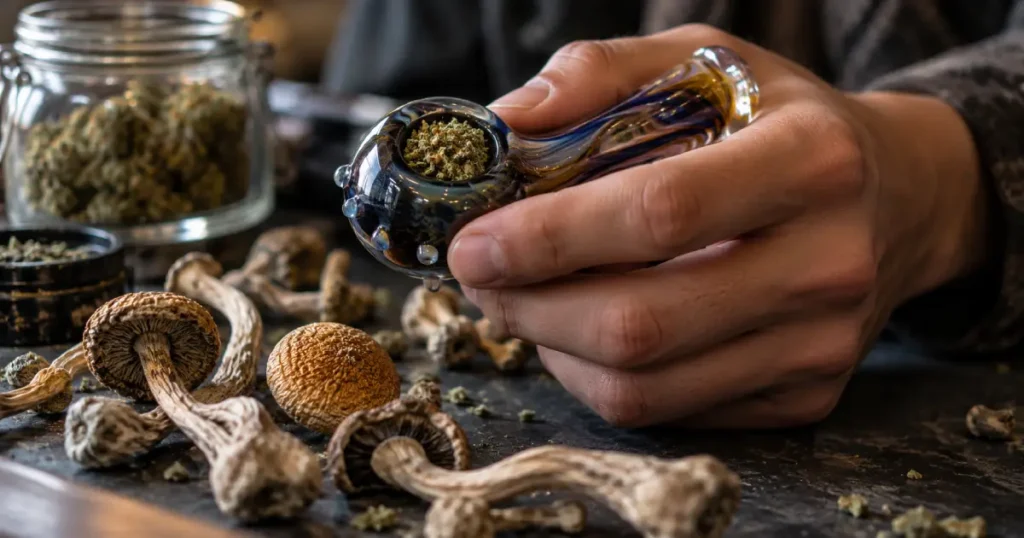
Technically, dried mushrooms can be burned and their smoke inhaled. But that does not mean smoking magic mushrooms is an effective, predictable, or safe way to experience psilocybin.
Magic mushrooms contain psilocybin, a naturally occurring psychedelic compound. After psilocybin enters your body, it is converted into psilocin, the compound primarily responsible for psychedelic effects. Research on psilocybin overwhelmingly focuses on oral administration rather than smoking. A recent systematic review of human pharmacokinetic studies found that nearly all included clinical datasets administered psilocybin orally.
That distinction matters.
There is little direct scientific evidence showing what happens when dried psilocybin mushrooms are burned and inhaled. Meanwhile, combustion introduces its own respiratory risks.
So, can you smoke magic mushrooms? Physically, yes. Scientifically, there is no good evidence that doing so provides a reliable psychedelic effect—and there are good reasons not to treat mushrooms like cannabis.
Here is what the science actually tells us.
What Are Magic Mushrooms?
Magic mushrooms are fungi that naturally contain psychedelic compounds, primarily psilocybin and psilocin.
Many belong to the genus Psilocybe, although psychedelic compounds occur in several mushroom genera.
Psilocybin is classified as a psychedelic, meaning a substance capable of significantly changing perception, mood, thought, and sensory processing. Psychedelics are sometimes grouped under the broader term hallucinogens.
This answers another common search question: are shrooms drugs?
Yes. Psilocybin is a psychoactive drug because it changes brain function and can alter perception, cognition, emotions, and behavior. SAMHSA categorizes psilocybin among classic psychedelics, alongside substances such as LSD and mescaline.
In the United States, psilocybin also remains federally controlled. Federal law currently places psilocybin in Schedule I under the Controlled Substances Act, although state and local policies have been evolving in some jurisdictions.
That legal classification is separate from ongoing clinical research into potential therapeutic applications.
Can You Smoke Shrooms?
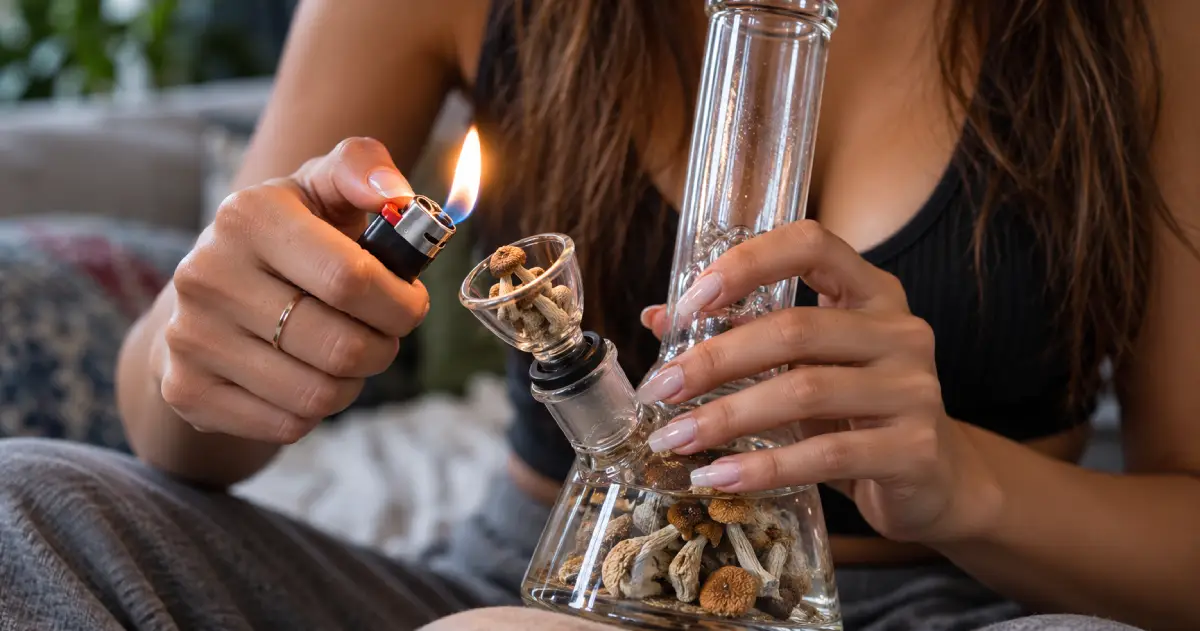
The simplest answer is that you can physically burn dried mushrooms and inhale the resulting smoke, but smoking shrooms is not an established or scientifically supported route of psilocybin administration.
Most documented human research involves oral psilocybin.
A 2025 systematic review examined published human pharmacokinetic research on psilocybin and its active metabolite, psilocin. Of the clinical datasets included, almost all involved oral administration, with one dataset involving intravenous administration. Smoking was not an established clinical administration route.
This creates an important evidence gap.
You may find anecdotal reports online from people claiming they felt something after smoking mushrooms. Others report no psychedelic effects whatsoever.
Anecdotes cannot establish whether an effect came from psilocybin, another substance used simultaneously, expectation, placebo effects, or another variable.
In other words, there is currently no reliable scientific basis for assuming that smoking shrooms will produce the same effects as orally consumed psilocybin.
Why Psilocybin Does Not Work Like Smoked Cannabis
Part of the confusion comes from comparing magic mushrooms with cannabis.
They work very differently.
Cannabis contains cannabinoids such as THC, or delta-9-tetrahydrocannabinol. Psilocybin mushrooms contain psychedelic tryptamines, principally psilocybin and psilocin.
Psilocybin is a prodrug. A prodrug is a compound that is converted by your body into another compound responsible for much of its pharmacological activity.
When psilocybin is taken orally, your body rapidly converts it into psilocin. Psilocin then interacts strongly with serotonin receptors, particularly the 5-HT2A receptor, which is closely associated with the characteristic psychedelic effects.
This metabolic process is well documented for oral psilocybin.
A 2025 systematic review reported that psilocybin is rapidly dephosphorylated—or chemically converted by removing a phosphate group—into psilocin. Human studies generally show psilocin reaching peak concentrations within a few hours after oral administration.
There is no comparable body of clinical evidence establishing the pharmacokinetics of burned mushroom material inhaled into the lungs.
That is why treating mushrooms like cannabis flower is scientifically questionable.
Does Heat Destroy Psilocybin?
You will frequently see a simple explanation online:
“Smoking shrooms doesn’t work because fire destroys psilocybin.”
The reality deserves more nuance.
Psilocybin and particularly psilocin can degrade under environmental and processing conditions, and thermal exposure can contribute to chemical changes. However, there is not a strong body of human research measuring exactly how much active compound survives when whole dried psychedelic mushrooms are combusted and inhaled.
That means it is too simplistic to assign a precise temperature at which every active compound instantly disappears.
What we can say confidently is that combustion exposes mushroom material to extremely different conditions from those used in clinical psilocybin research.
Furthermore, psilocin itself presents stability challenges. Research examining psilocin derivatives has demonstrated degradation during prolonged thermal exposure, although laboratory conditions cannot be directly equated with burning mushroom material.
The practical conclusion remains straightforward: smoking is not a validated delivery method for psilocybin.
Claims that it reliably creates a faster psychedelic experience are not supported by good clinical evidence.
What Happens If You Smoke Magic Mushrooms?
This is where separating evidence from internet anecdotes becomes especially important.
There are currently insufficient controlled human data to give a reliable timeline, dose-response curve, or expected psychoactive effect for smoked mushrooms.
Some people online describe mild effects. Others report nothing.
Neither tells us much scientifically.
What you can predict more confidently is exposure to combustion products.
Burning organic material creates smoke containing gases and fine particles. Those substances can irritate your airways and lungs. The risks become more complicated if mushrooms are combined with cannabis, tobacco, or another substance.
Smoking mushrooms also means inhaling material from a fungus that was never intended or tested as an inhalable product.
So even before considering psilocybin’s psychoactive effects, smoking introduces a separate respiratory exposure.
Can Smoking Shrooms Make You Trip?
There is no convincing clinical evidence demonstrating that smoking dried magic mushrooms produces a predictable psilocybin trip.
That is a more scientifically accurate answer than saying it is either absolutely impossible or reliably effective.
Most scientific information about the psychedelic experience comes from oral psilocybin.
When psilocybin is consumed orally and metabolized into psilocin, the latter interacts with serotonin receptors in the brain. The resulting effects can include altered visual perception, changes in time perception, intensified emotions, unusual thought patterns, and hallucinations.
Those findings cannot simply be transferred to smoked mushroom material.
The pharmacokinetics—the way a drug is absorbed, distributed, metabolized, and eliminated—can change substantially depending on how a substance enters the body.
Without controlled inhalation studies, there is no scientifically established “smoked shroom dose” or predictable smoked onset and duration.
Is Smoking Shrooms Dangerous?
There are several potential concerns.
First is the smoke itself.
Burning organic material creates particulates and other combustion by-products that your respiratory system must handle. This is one reason inhaling burned mushroom tissue cannot be considered harmless simply because mushrooms are naturally occurring.
There is also uncertainty about contaminants.
Poorly stored mushrooms may contain mold, bacteria, environmental contaminants, or other unwanted material. Heating something does not automatically make inhalation safe.
Another major concern is combining substances.
Someone attempting to smoke mushroom material might mix it with cannabis or tobacco to make it burn more easily. Doing so creates a polysubstance situation in which effects become harder to predict.
Health authorities caution that combining psychedelics with other substances can alter risks and make adverse reactions less predictable.
Most importantly, there is no established benefit that offsets these additional uncertainties.
What Does Psilocybin Normally Do to Your Body?
Understanding oral psilocybin helps explain why smoking it is such an uncertain proposition.
Once psilocybin has been converted into psilocin, psilocin acts primarily through the brain’s serotonin system.
Serotonin is a neurotransmitter—a chemical messenger involved in functions including mood, perception, sleep, and cognition.
Psilocin has substantial activity at the serotonin 5-HT2A receptor. Activation of this receptor is considered central to the subjective effects of classic psychedelics.
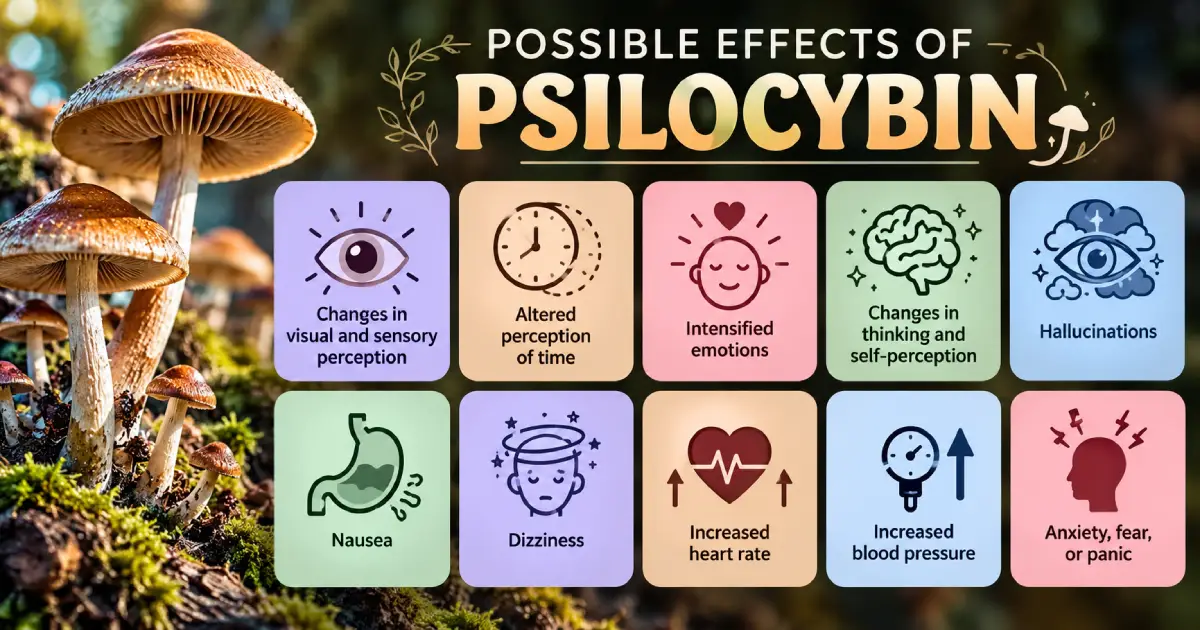
Possible effects of psilocybin can include:
- changes in visual and sensory perception
- altered perception of time
- intensified emotions
- changes in thinking and self-perception
- hallucinations
- nausea
- dizziness
- increased heart rate
- increased blood pressure
- anxiety, fear, or panic
Experiences can vary significantly between individuals and situations. Dose, physical health, psychological state, environment, expectations, and the use of other substances may all influence the experience.
Some people experience highly distressing reactions sometimes called bad trips, which may involve intense fear, paranoia, confusion, or panic.
How Long Do Shrooms Normally Last?
For orally consumed mushrooms, psychedelic effects are generally measured in hours rather than minutes.
Poison Control reports that effects after eating fresh or dried psilocybin mushrooms can begin within roughly 20 minutes, with effects lasting several hours. Individual experiences vary considerably.
The pharmacological timeline is related to the conversion of psilocybin into psilocin and the subsequent distribution and elimination of psilocin.
Recent pharmacokinetic reviews have estimated a psilocin elimination half-life generally measured in a range of roughly a few hours, depending on the study and administration conditions.
A half-life describes approximately how long it takes for the concentration of a substance in the body to decrease by half.
Again, those numbers describe studied administration methods—primarily oral psilocybin.
They should not be used to predict what happens from smoking mushrooms.
Can You Overdose on Mushrooms?
Another common question is can you overdose on mushrooms?
The answer requires distinguishing between a classic fatal drug overdose and a dangerous adverse reaction.
Poison Control states that ingesting enough psilocybin mushrooms to cause a conventional overdose is difficult, but that does not mean magic mushrooms are risk-free. Serious behavioral, psychological, or physical complications can still occur.
The DEA similarly notes that deaths exclusively from acute overdose involving psilocybin-containing mushrooms are less common than with many other substances. However, serious outcomes can occur through accidents, dangerous behavior, polysubstance use, or mistakenly consuming poisonous mushrooms.
Possible severe reactions can involve extreme agitation, panic, confusion, psychosis-like symptoms, unsafe behavior, or complications involving other drugs.
There is another major risk that has nothing to do with the amount of psilocybin:
mushroom misidentification.
Some poisonous mushrooms can resemble psychedelic species. Eating a toxic species mistaken for a psilocybin-containing mushroom can cause severe poisoning and potentially death. NCCIH specifically identifies poisonous-mushroom misidentification as an important safety concern.
So while fatal toxicity directly attributable to psilocybin appears uncommon, “you cannot overdose on shrooms” is an unsafe oversimplification.
Are Shrooms Drugs or Natural Supplements?
Shrooms are drugs.
The fact that psilocybin occurs naturally in fungi does not change its pharmacological status.
Many psychoactive drugs originate in plants or fungi. What matters pharmacologically is whether a compound changes biological processes in the body.
Psilocybin clearly does.
It is a psychedelic drug that is converted into psychoactive psilocin and alters serotonin signaling.
Magic mushrooms therefore should not be treated as ordinary culinary mushrooms, vitamins, or dietary supplements.
Products marketed using terms such as “mushroom,” “functional mushroom,” or “mushroom gummy” also should not automatically be assumed to contain psilocybin.
For example, mushrooms such as lion’s mane, reishi, and cordyceps are different from psilocybin-containing species.
Likewise, a commercial product marketed with psychedelic-looking mushroom branding may contain compounds other than psilocybin. SAMHSA warns that products sold as hallucinogens can contain unexpected or unknown substances.
The label alone is not proof of what is inside.
Are Magic Mushrooms Addictive?
Psilocybin does not have the same dependence profile as substances such as nicotine or opioids.
However, that does not mean psychedelic use is automatically harmless.
Repeated psilocybin exposure can produce tolerance, meaning a person experiences reduced effects after repeated use and may require more of the substance to experience similar effects.
More broadly, a person’s relationship with any psychoactive substance can become problematic even when severe physical dependence is uncommon.
The risks surrounding psychedelics are often less about classic withdrawal and more about unpredictable psychological effects, impaired judgment, interactions with other substances, underlying psychiatric vulnerabilities, and unsafe environments.
Can Shrooms Interact With Other Drugs?
Potential interactions deserve more attention than many articles give them.
Psilocybin acts on serotonin pathways, so combining it with medications or substances that also affect serotonin can create unpredictable pharmacological effects.
Memorial Sloan Kettering notes potential interactions involving serotonergic drugs and other medications, although the evidence for many specific combinations remains incomplete.
Using multiple psychoactive substances at the same time can also make it harder to determine which substance is responsible for an adverse reaction.
This is especially relevant to smoking shrooms because mushroom material may be combined with cannabis or tobacco.
“Natural” does not mean interaction-free.
Anyone taking prescription medication should discuss possible psychedelic interactions with a qualified healthcare professional rather than relying on anecdotal advice.
What About Psilocybin Therapy?
Scientific interest in psilocybin has grown substantially, but clinical research should not be confused with unsupervised recreational use.
Researchers are studying psilocybin in controlled environments for conditions including depression and other mental health disorders.
Clinical studies typically involve carefully characterized psilocybin, screening, controlled dosing, monitoring, and psychological support.
That is fundamentally different from buying unidentified mushroom products or experimenting with smoking dried fungi.
NCCIH notes that research into psilocybin’s potential therapeutic applications is ongoing while also emphasizing that experiences can be unpredictable and that adverse effects can occur.
Promising research therefore does not establish smoking mushrooms as a therapeutic method.
It does not.
Is Psilocybin Legal in the United States?
At the federal level, psilocybin remains a Schedule I controlled substance.
That means federal law generally prohibits its unauthorized possession, manufacture, and distribution.
The situation becomes more complicated at state and local levels.
Some jurisdictions have decriminalized or deprioritized enforcement involving certain psychedelic substances, while others have created specific regulated frameworks. These policies can change and do not necessarily eliminate federal restrictions.
Decriminalization also does not necessarily mean unrestricted legal retail sale.
If legality matters to you, check current federal, state, and local rules rather than assuming that a policy in one city or state applies elsewhere.
When Should You Seek Medical Help?
An unexpected psychedelic reaction should be taken seriously when severe symptoms appear.
Emergency medical attention may be appropriate for symptoms such as seizures, loss of consciousness, severe agitation, difficulty breathing, dangerous confusion, or behavior that creates an immediate risk of injury.
If mushroom poisoning or an unexpected exposure is suspected in the United States, Poison Control can provide case-specific guidance at 1-800-222-1222. For an immediate life-threatening emergency, call 911.
Do not assume that every product sold as “shrooms” contains only psilocybin.
Unexpected symptoms may involve another ingredient, contamination, a poisonous mushroom species, or an interaction with another substance.
Can You Smoke Shrooms? The Bottom Line
So, can you smoke shrooms?
You can physically burn dried mushrooms, but there is no solid clinical evidence establishing smoking as an effective or predictable way to administer psilocybin.
Most human research has examined psilocybin taken orally. Once inside the body, psilocybin is converted into psilocin, which interacts primarily with serotonin receptors and produces the characteristic psychedelic effects.
Smoking dried mushrooms adds another problem: combustion.
Instead of assuming mushrooms behave like cannabis flower, it is better to recognize that they contain entirely different compounds with different pharmacology.
The same caution applies to questions such as can you overdose on mushrooms and are shrooms drugs. Psilocybin is a psychoactive drug. Direct fatal toxicity appears uncommon compared with some other drugs, but severe psychological reactions, accidents, drug interactions, mushroom misidentification, and other complications remain possible.
For readers interested in cannabis education rather than psychedelic experimentation, Buy My Weed USA offers helpful guides covering cannabis flower, concentrates, edibles, vapes, cannabinoids, and responsible-use topics. Whether you’re researching products or looking for the best marijuana dispensary in the US, understanding how different substances work—and where the scientific evidence ends—is an important place to start. Different psychoactive products can have very different effects, risks, and methods of use, so you should never assume they can all be consumed in the same way.
References
National Center for Complementary and Integrative Health (NCCIH). (May 2024). Psilocybin for Mental Health and Addiction: What You Need To Know. Available at:
https://www.nccih.nih.gov/health/psilocybin-for-mental-health-and-addiction-what-you-need-to-know
Meshkat S, et al. (2025 Mar 25). Pharmacokinetics of Psilocybin: A Systematic Review. Pharmaceutics. Available at: https://pubmed.ncbi.nlm.nih.gov/40284409/
Drug Enforcement Administration (DEA). (nd). Hallucinogens. Available at:
https://www.dea.gov/factsheets/hallucinogens
