
Pre Rolls
Pre-Rolled Joints vs. Hand-Rolled Joints: Which One Is Better?
Aug
Few cannabis formats are as recognizable as the rolled joint. It is simple, portable, requires no glassware, and lets you enjoy flower in one of its most traditional forms.
But there is still one decision to make: Should you buy prerolled joints or roll your own?
At first glance, the difference seems straightforward. A pre-roll comes prepared for you, while a hand-rolled joint requires you to grind the flower, choose your paper, and do the rolling yourself. In practice, however, the choice affects much more than convenience.
Flower quality, freshness, price, customization, consistency, size, airflow, and even how evenly your joint burns can vary depending on which option you choose.
Neither is automatically better. Pre-rolls make sense when convenience and consistency are priorities. Rolling by hand gives you substantially more control over the flower, paper, size, and construction of your joint.
Below, we’ll compare pre-rolled joints vs. hand-rolled joints from every important angle so you can decide which option makes the most sense for you.
What Is a Pre-Rolled Joint?
A pre-rolled joint, commonly shortened to pre-roll, is cannabis flower that has already been ground and packed or rolled into smoking paper before you buy it.
Most commercial pre-rolls have three basic components:
- Ground cannabis flower
- Rolling paper or a paper cone
- A tip, filter, or crutch at the mouth end
A crutch is a small piece of folded or rolled material—usually paper or cardboard—that provides structure at the mouthpiece and helps maintain airflow.
Pre-rolls are essentially the ready-to-use version of loose cannabis flower. You don’t need to own a grinder, learn a joint roll technique, or spend several minutes preparing everything before your session.
Pre-roll sizes vary considerably. Half-gram and one-gram products are common, while manufacturers also sell smaller “mini” joints and multi-packs containing several individual pre-rolls.
Some products are infused pre-rolls. These combine cannabis flower with concentrates such as kief, hash, or cannabis oil. Kief refers to the loose, resin-rich trichomes separated from cannabis flower. Because concentrates can significantly increase cannabinoid content, consumers should distinguish infused products from conventional flower-only pre-rolls when reading a label.
The simplicity of the format explains much of its appeal: open the package and the preparation has already been done.
What Is a Hand-Rolled Joint?
A hand-rolled joint is one you prepare yourself using loose cannabis flower and rolling paper.
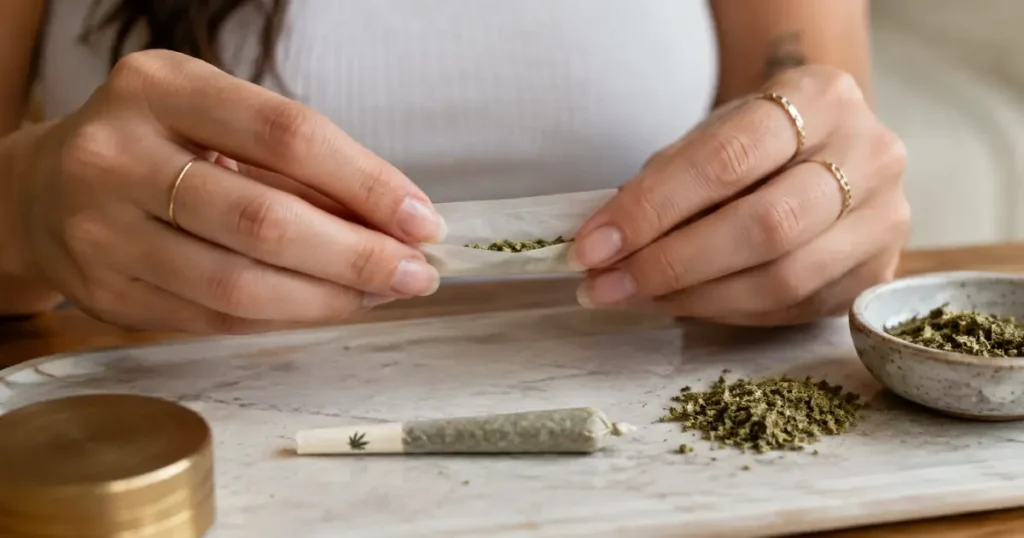
Typically, you grind the flower, distribute it along the paper, shape it, tuck the edge of the paper underneath, roll it closed, seal it, and finish the open end. You can also add a crutch before rolling.
Unlike buying a finished pre-roll, making your own joint puts you in control of nearly every variable.
You choose:
- The cannabis flower
- How much flower goes inside
- How finely it is ground
- The type and size of rolling paper
- Whether to use a crutch
- How tightly or loosely the joint is packed
- The finished shape and size
That flexibility is the biggest advantage of rolling your own. It is also the biggest drawback if you haven’t developed the technique yet.
A poorly constructed joint can be too tight to draw from, too loose to burn properly, or unevenly packed. Learning how to joint roll consistently takes some practice.
Once you’ve developed the skill, however, rolling becomes much easier and allows you to tailor each joint to the session.
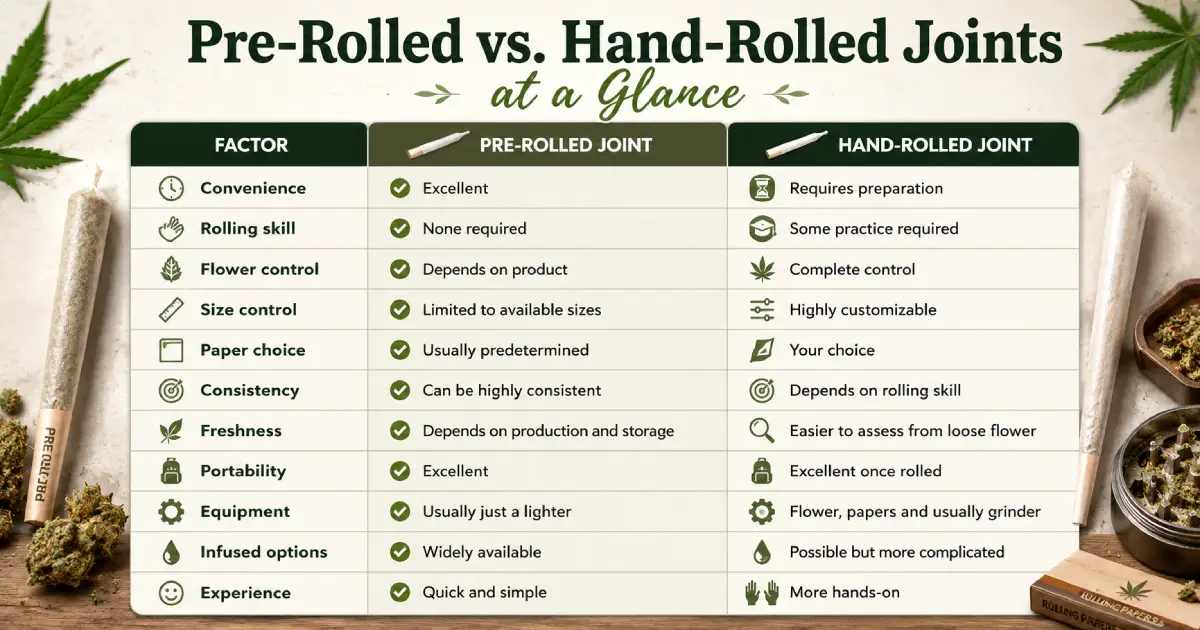
Pre-Rolled vs. Hand-Rolled Joints at a Glance
Here is the simplest way to compare them:
| Factor | Pre-Rolled Joint | Hand-Rolled Joint |
| Convenience | Excellent | Requires preparation |
| Rolling skill | None required | Some practice required |
| Flower control | Depends on product | Complete control |
| Size control | Limited to available sizes | Highly customizable |
| Paper choice | Usually predetermined | Your choice |
| Consistency | Can be highly consistent | Depends on rolling skill |
| Freshness | Depends on production and storage | Easier to assess from loose flower |
| Portability | Excellent | Excellent once rolled |
| Equipment | Usually just a lighter | Flower, papers and usually grinder |
| Infused options | Widely available | Possible but more complicated |
| Experience | Quick and simple | More hands-on |
The better choice therefore depends on what you value most.
Convenience: Pre-Rolls Win
If convenience is the priority, prerolled joints have a clear advantage.
Imagine you want to enjoy flower but don’t have rolling papers, a grinder, or the patience to prepare a joint. A pre-roll eliminates all three problems.
This makes pre-rolls especially useful for consumers who:
- Don’t know how to roll
- Have difficulty handling small rolling papers
- Don’t own cannabis accessories
- Want a quick, ready-to-use format
- Prefer not to prepare flower themselves
They’re also convenient when you want to sample a particular cultivar without purchasing a larger amount of loose flower.
With a hand roll, you first need flower and paper and will generally want a grinder. You then have to prepare and construct the joint.
Experienced rollers might accomplish that quickly, but a pre-roll still wins on pure speed.
Winner for convenience: Pre-rolled joints.
Control and Customization: Hand-Rolled Joints Win
Rolling your own reverses the equation when customization matters.
When you make a joint from scratch, you control what goes into it and how it is built.
Prefer a smaller joint? Use less flower.
Want a longer session? Use a larger paper and more flower.
Prefer hemp or rice paper? Choose it yourself.
Want a specific strain or blend of flower? You’re in control of that too.
You can also adjust the grind and packing density. These variables influence airflow and combustion, although there isn’t one universally “perfect” joint because papers, flower moisture, size, and individual preferences differ.
A commercial pre-roll gives you fewer choices after purchase. You select among the products and sizes the producer offers, but the manufacturer has already made the construction decisions.
Winner for customization: Hand-rolled joints.
Flower Quality: It Depends on What You Buy
One of the oldest criticisms of pre-rolls is that they can contain lower-quality material rather than the attractive buds you see in jars of loose flower.
There is some truth behind the concern, but it shouldn’t be applied to every pre-roll.
Different manufacturers use different starting materials. Depending on the product, the contents can include ground whole flower or smaller cannabis material such as shake.
Shake consists of small pieces of cannabis flower that naturally break away from larger buds during handling and storage. Trim, by comparison, generally refers to leaves and other plant material removed when cannabis buds are manicured after harvest.
These terms aren’t interchangeable, and their presence doesn’t automatically tell you everything about a product’s chemical composition.
The larger issue is visibility. With loose flower, you can usually inspect the material before you grind it. Once cannabis has been ground and placed inside a rolled joint, visual inspection becomes much harder.
That’s why the producer and product information matter when buying pre-rolls.
Look for clear labeling and, where applicable under local regulations, cannabinoid testing information and other required product details.
A hand-rolled joint gives you the advantage of knowing exactly which loose flower you put inside it.
Winner for transparency and flower control: Hand-rolled joints.
Consistency and Construction: Quality Pre-Rolls Have an Advantage
Rolling a beautiful joint by hand is a skill.
Beginners often run into problems such as:
- Loose sections
- Overpacking
- Uneven shapes
- Poor airflow
- Flower falling from the end
- Joints that repeatedly go out
A well-manufactured pre-roll removes much of that learning curve.
Commercial producers can use standardized filling and packing processes, which can make the size and construction more repeatable from one joint to another.
That doesn’t mean every pre-roll burns perfectly. Manufacturing quality, flower moisture, particle size, packing density, paper, transportation, and storage can all affect performance.
Hand rolls can be exceptionally consistent too—especially when made by an experienced roller—but your results depend on your technique.
Winner for out-of-the-package consistency: High-quality pre-rolls.
Which Type Burns Better?
This category doesn’t have a universal winner.
An evenly packed joint with suitable airflow should generally burn more predictably than one with major differences in density along its length, regardless of whether a person or machine prepared it.
One common problem is canoeing, sometimes called running. This occurs when one side of the paper burns faster than the other, leaving an uneven burn line.
Canoeing can be influenced by several factors, including uneven packing and how the joint is lit.
A poorly made pre-roll can canoe. So can a poorly made hand roll.
Experienced rollers may prefer handmade joints because they can adjust the construction based on the flower they’re using. Other consumers prefer professionally prepared pre-rolls because they don’t have to reproduce the same roll every time.
Winner for burn: Tie—construction and product quality matter more than the category.
Freshness: Hand-Rolled Joints Offer More Control
Freshness is another area where rolling your own has an advantage.
With a hand roll, you can keep your cannabis flower stored appropriately and grind only what you intend to use.
A pre-roll has already been ground before it reaches you. Grinding cannabis increases its exposed surface area, so packaging and storage become particularly important.
Rather than assuming every pre-roll has a specific universal shelf life, inspect the package for applicable production, packaging, or expiration information and follow the manufacturer’s storage instructions.
For either format, protect cannabis from excessive heat, direct sunlight, and unnecessary exposure to air. Keep products secured away from children and pets.
If you’re buying pre-rolls, packaging that helps protect the joint from crushing and environmental exposure is a practical advantage.
Winner for direct freshness control: Hand-rolled joints.
Cost: Look at More Than the Sticker Price
Is rolling your own cheaper than buying pre-rolls?
Sometimes—but not automatically.
With loose flower, you’re purchasing cannabis and providing the papers, grinder, and labor yourself. If you already own the accessories and regularly purchase flower, rolling your own may provide good value.
Pre-roll pricing can incorporate more than the flower itself. You’re also paying for manufacturing, packaging, convenience, and—in some cases—specialized ingredients such as concentrates.
The most useful comparison is therefore not simply:
“Which joint costs less?”
Instead, consider:
Price + amount of cannabis + product quality + convenience + cannabinoid content
A single pre-roll can also be an economical way to try something new without purchasing a larger package of flower.
If value matters to you, compare products using their actual weight and label information rather than assuming all joints contain the same amount.
Winner for potential everyday value: Hand-rolled joints.
Winner for low-commitment sampling: Pre-rolled joints.
Pre-Rolls Are Easier for Beginners
If you’ve never rolled before, there’s no mystery about which format is easier.
Pre-rolls eliminate the learning curve.
Rolling paper is thin, and shaping ground flower into a stable cylinder or cone without tearing the paper takes coordination. Your first few attempts probably won’t look like professionally made joints.
That doesn’t mean rolling is extraordinarily difficult. It’s simply a skill that improves with repetition.
If learning the ritual appeals to you, rolling by hand can be rewarding. If you just want a ready-made format without mastering another cannabis skill, pre-rolls make more sense.
This is one reason dispensary guides frequently position pre-rolls as an accessible option for newer consumers.
Pre-Rolls Offer More Ready-Made Specialty Options
Another advantage of today’s pre-roll market is variety.
Beyond standard flower joints, you may encounter:
Mini pre-rolls: Smaller joints intended for consumers who don’t want a full-size product.
Multi-packs: Several pre-rolls packaged together, often in smaller individual sizes.
Infused pre-rolls: Flower combined with cannabis concentrate, potentially producing substantially higher cannabinoid levels than flower alone.
These products let you explore formats that can be more cumbersome to prepare yourself.
Pay particular attention to labels on infused products. High-THC cannabis can produce stronger adverse reactions in some people, and NIDA notes that unexpectedly high potency or consuming too much can be associated with anxiety, fear, distrust, or panic.
If you’re accustomed to ordinary flower, don’t assume an infused joint will have comparable potency simply because it looks similar.
Hand Rolling Turns Preparation Into Part of the Experience
Not every advantage can be measured in minutes or dollars.
For some cannabis consumers, rolling is part of the ritual.
Choosing the flower, grinding it, arranging the paper, forming the joint, and finishing the roll creates a hands-on experience that a ready-made product intentionally removes.
You can also adapt your joint roll to the occasion. A smaller personal joint, a longer roll intended for sharing among adults where lawful, or a particular paper can all be prepared from the same supply of flower.
That experience has value if you enjoy the process.
For someone who sees rolling as a chore, it doesn’t.
This is where the “better” joint becomes entirely personal.
How to Evaluate a Pre-Rolled Joint Before Buying
Not all prerolled joints are equivalent, so don’t choose solely by package design or THC percentage.
Where products are legally sold and regulated, consider these factors.
1. Flower or input material
Look for information about what is actually inside the joint. Product transparency helps you understand what you’re paying for.
2. Cannabinoid information
THC—delta-9-tetrahydrocannabinol—is the primary intoxicating cannabinoid associated with cannabis. CBD, or cannabidiol, is another major cannabinoid and does not produce the same intoxicating effect as THC.
Higher THC isn’t automatically “better.” Choose products appropriate for your experience and preferences.
3. Infused vs. non-infused
Check whether the product contains only flower or has added concentrate. This can substantially change its cannabinoid content.
4. Net weight
Look at how much cannabis you’re actually purchasing. A 0.5-gram pre-roll and a one-gram joint shouldn’t be compared as though they are identical products.
5. Packaging
A joint can be damaged when crushed or exposed to poor storage conditions. Protective packaging matters.
6. Producer information and required testing
When purchasing cannabis in a regulated state market, review the information required on the product label and buy through lawful channels.
These details tell you far more than simply choosing whichever package claims the highest THC number.
When Is a Hand-Rolled Joint Better?
A hand-rolled joint is probably the better option when you:
- Already buy loose cannabis flower
- Enjoy the process of preparing cannabis
- Want complete control over what goes into your joint
- Have a preferred rolling paper
- Want to customize joint size
- Care about inspecting the flower before grinding it
- Have developed reliable rolling skills
For enthusiasts who view flower selection and preparation as part of the experience, rolling your own is difficult to beat.
You’re building the joint specifically for yourself rather than choosing a predetermined format.
When Are Pre-Rolled Joints Better?
Pre-rolls make more sense when you:
- Prioritize convenience
- Don’t know how to roll
- Don’t want to carry a grinder and papers
- Want to try a product without buying as much loose flower
- Prefer standardized sizing
- Want ready-made mini or infused options
- Simply don’t enjoy rolling
There’s nothing inherently more authentic about making every joint yourself.
Sometimes you want the ritual. Sometimes you want convenience.
Pre-rolls exist for the second situation.
Are Pre-Rolled Joints Safer Than Hand-Rolled Joints?
You shouldn’t assume so.
Both conventional pre-rolls and hand-rolled cannabis joints involve combustion, meaning plant material is burned and smoke is inhaled.
According to the CDC, smoked cannabis can harm lung tissue, and cannabis smoke contains many of the same toxins, irritants, and carcinogens found in tobacco smoke. Cannabis smoking is also associated with increased bronchitis, cough, and mucus production, although more research is needed to determine its relationship with diseases such as lung cancer and COPD.
Secondhand cannabis smoke isn’t harmless either. The CDC reports that it contains THC as well as many of the toxic and cancer-causing chemicals present in tobacco smoke.
That means the question of pre-roll vs. hand roll should generally be viewed as one of format and preference, not as a choice between a “safe” and “unsafe” form of smoking.
Cannabis can also impair reaction time, coordination, perception, and decision-making, so you should not drive after using it. Combining cannabis with alcohol can increase impairment.
What About Blunts?
Joints and blunts are sometimes discussed together, but they aren’t necessarily the same thing.
A conventional cannabis joint uses rolling paper, commonly made from materials such as hemp, rice, or other paper fibers.
Traditionally, a blunt uses a cigar or tobacco-leaf wrapper. Consequently, traditional blunts can introduce tobacco and nicotine exposure that isn’t present in an ordinary paper cannabis joint.
Some modern products marketed with blunt-style terminology use non-tobacco or hemp-based wraps, however, so check the product materials rather than relying on the name alone.
If you’re specifically comparing a rolled joint with a pre-roll, make sure you’re comparing products with similar wrappers and contents.
Pre-Rolled vs. Hand-Rolled Joints: Which One Is Better?
After comparing the two, there’s no universal winner.
Choose a pre-rolled joint if convenience is your priority. It eliminates grinding, papers, rolling technique, and preparation. Quality pre-rolls can provide predictable sizing and make it easy to explore different flower and specialty formats.
Choose a hand-rolled joint if control is your priority. You decide exactly which flower, paper, quantity, grind, and construction goes into the finished joint.
A lot of experienced cannabis consumers don’t choose one exclusively.
You might roll fresh flower yourself when you’re at home and have time to enjoy the preparation, while keeping pre-rolls available when convenience matters.
The right question isn’t necessarily Which type of joint is objectively better?
It’s Which one is better for the way you consume cannabis?
Frequently Asked Questions About Pre-Rolled and Hand-Rolled Joints
Are pre-rolled joints as good as hand-rolled joints?
They can be. Quality depends on the cannabis inside, its storage, the paper, and how well the joint is constructed. A well-made pre-roll can outperform a poorly made hand roll, while an experienced roller using flower they personally selected may prefer the control of rolling by hand.
Do pre-rolls contain real cannabis flower?
Pre-rolls contain cannabis plant material, but the exact input can differ between manufacturers and products. Some advertise ground whole flower, while others may use smaller flower material such as shake. Read available product information instead of assuming every pre-roll is made the same way.
Why do some pre-rolls burn unevenly?
Uneven burning, commonly called canoeing, can be influenced by inconsistent packing, lighting, moisture, and other construction factors. Both pre-rolls and hand-rolled joints can burn unevenly.
Is it cheaper to roll your own joints?
It can be, particularly if you already purchase loose flower and own a grinder and other accessories. However, prices differ by product and market. Compare the cannabis weight, quality, cannabinoid information, and price rather than looking only at the price of one joint.
Are pre-rolls good for beginners?
Their convenience makes them easier to prepare because no rolling skill is required. Beginners should still check the product label carefully, particularly whether a pre-roll is infused and its cannabinoid content. Cannabis containing THC is intoxicating and carries health and safety risks.
Are infused pre-rolls stronger than regular joints?
They often contain more cannabinoids because cannabis concentrate has been added to the flower. The actual potency varies considerably, so use the product’s tested cannabinoid information rather than assuming potency from the words “infused” or “premium.”
How much cannabis is in a pre-roll?
There is no single standard amount. Products are commonly available in different sizes, including approximately half-gram and one-gram formats, while mini joints can contain less. Always check the stated net weight.
Do you need a grinder for a hand-rolled joint?
You don’t strictly need one, but a grinder makes it easier to break cannabis flower into more consistently sized pieces for rolling. Grinding too finely or packing too densely can restrict airflow, so the goal isn’t to turn the flower into powder.
The Bottom Line
The contest between pre-rolled joints and hand-rolled joints comes down to two words: convenience and control.
Pre-rolls maximize convenience. They’re prepared ahead of time, require no rolling skill, and are available in numerous sizes and styles.
Hand-rolled joints maximize control. You choose your flower, paper, size, grind, and construction while making preparation part of the experience.
Neither format can guarantee better cannabis simply because of how it was rolled. The quality of the flower, manufacturing or rolling technique, freshness, storage, and product transparency all matter.
If convenience sounds more appealing, explore the pre-roll selection available from BuyMyWeedUSA.com where lawful. If you’d rather build your own perfect rolled joint, browse quality flower and choose a cultivar that fits your preferences.
Whichever route you take, read product labels carefully, know your local laws, keep cannabis away from children and pets, and consume responsibly.
A Note on US Cannabis Laws
Cannabis laws vary substantially by state and jurisdiction. At the federal level, marijuana remains listed as a Schedule I controlled substance as of August 2026, although the federal government has been considering a proposed transfer to Schedule III through formal rulemaking proceedings. A proposed scheduling change should not be treated as a finalized change in federal law.
Always verify the laws that apply where you live, including rules concerning possession, purchasing, age restrictions, public consumption, transportation, and delivery.
References
Ward, A. (2024, July 22nd). What is a Pre Roll? Everything You Need to Know. Available at: https://www.nuggmd.com/blog/what-is-a-pre-roll-everything-you-need-to-know
Weedmaps. (2024, April 23). What is an infused pre-roll?. Available at: https://weedmaps.com/learn/products-and-how-to-consume/infused-prerolls
